CAS 89466-08-0
:2-Hydroxybenzeneboronic acid
Description:
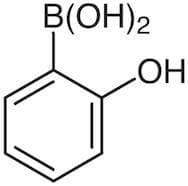
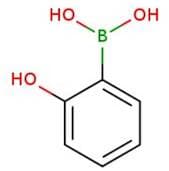
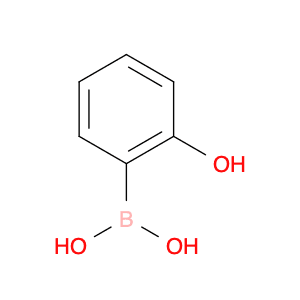
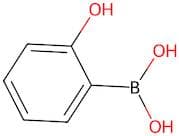
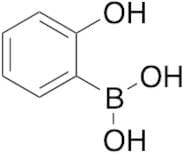
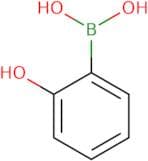
2-Hydroxybenzeneboronic acid, also known as salicylboronic acid, is an organoboron compound characterized by the presence of a boronic acid functional group attached to a hydroxyl-substituted benzene ring. Its molecular structure features a phenolic hydroxyl group (-OH) ortho to the boronic acid group (-B(OH)2), which contributes to its unique reactivity and properties. This compound is typically a white to off-white solid and is soluble in polar solvents such as water and alcohols, making it useful in various chemical applications. 2-Hydroxybenzeneboronic acid is known for its ability to form reversible covalent bonds with diols, which is significant in the development of sensors and drug delivery systems. Additionally, it plays a role in Suzuki-Miyaura cross-coupling reactions, facilitating the formation of carbon-carbon bonds in organic synthesis. Its boronic acid functionality also allows it to participate in complexation with biomolecules, making it valuable in biochemical research and applications. Overall, 2-Hydroxybenzeneboronic acid is a versatile compound with important implications in both synthetic and medicinal chemistry.
Formula:C6H7BO3
InChI:InChI=1/C6H7BO3/c8-6-4-2-1-3-5(6)7(9)10/h1-4,8-10H
SMILES:c1ccc(c(c1)B(O)O)O
Synonyms:- 2-Boronophenol
- 2-Hydroxyphenylboronic acid
Sort by
Purity (%)
0
100
|
0
|
50
|
90
|
95
|
100
Found 7 products.
2-Hydroxyphenylboronic Acid (contains varying amounts of Anhydride)
CAS:Formula:C6H7BO3Color and Shape:White to Light yellow to Light orange powder to crystalMolecular weight:137.932-Hydroxybenzeneboronic acid, 97%
CAS:2-Hydroxybenzeneboronic acid is used as a pharmaceutical intermediate. This Thermo Scientific Chemicals brand product was originally part of the Alfa Aesar product portfolio. Some documentation and label information may refer to the legacy brand. The original Alfa Aesar product / item code or SKU reFormula:C6H7BO3Purity:97%Color and Shape:Powder, White to pale creamMolecular weight:137.932-Hydroxyphenylboronic acid
CAS:Formula:C6H7BO3Purity:96%Color and Shape:SolidMolecular weight:137.92902-Hydroxybenzeneboronic acid
CAS:2-Hydroxybenzeneboronic acid
Formula:C6H7BO3Purity:≥95%Color and Shape: white to off-white powderMolecular weight:137.92898g/mol2-Hydroxyphenylboronic acid
CAS:Formula:C6H7BO3Purity:98%Color and Shape:White to off-white solidMolecular weight:137.932-Hydroxyphenylboronic acid
CAS:Controlled ProductApplications 2-Hydroxyphenylboronic acid
Formula:C6H7BO3Color and Shape:NeatMolecular weight:137.93(2-Hydroxyphenyl)boronic acid
CAS:(2-Hydroxyphenyl)boronic acid is an organic compound that contains a boronate ester group and a hydroxyl group. It is used in the synthesis of lysine-containing peptides, proteins, and other compounds. (2-Hydroxyphenyl)boronic acid is synthesized by cross-coupling reactions using palladium-catalyzed coupling reactions. The most common type of reaction is the Suzuki coupling reaction, which involves the addition of an aryl halide to an aryl or vinyl boronate ester. This reaction is carried out at elevated temperature in organic solvents such as tetrahydrofuran or dioxane. The yield for this reaction can be improved by using catalytic amounts of palladium acetate, which speeds up the rate at which the reaction occurs. The use of catalysts also decreases the need for high temperatures, making it possible to perform this process atFormula:C6H7BO3Purity:Min. 95%Molecular weight:137.93 g/mol