CAS 895470-67-4
:Cardioprotectant
Description:
The chemical substance known as "Cardioprotectant" with the CAS number 895470-67-4 is a compound that has been studied for its potential protective effects on cardiovascular health. While specific characteristics can vary, cardioprotectants generally exhibit properties that help to mitigate damage to heart tissues during ischemic events, such as heart attacks. These substances may work by improving blood flow, reducing oxidative stress, and enhancing cellular survival mechanisms. They often possess antioxidant properties and can influence various signaling pathways involved in cardiac function. The pharmacological profile of cardioprotectants may include effects on inflammation, apoptosis, and metabolic regulation within cardiac cells. Research into this compound may also explore its efficacy in clinical settings, potential side effects, and mechanisms of action. As with any chemical substance, understanding its safety, dosage, and interactions with other medications is crucial for therapeutic applications. Further studies are typically necessary to fully elucidate its characteristics and potential benefits in cardiology.
Formula:C16H12ClN3OS2
Synonyms:- Cardioprotectant 312
- CP-312
- Cardioprotectant
- CP 312
- CP312
Sort by
Purity (%)
0
100
|
0
|
50
|
90
|
95
|
100
Found 3 products.
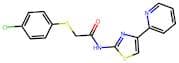
2-((4-Chlorophenyl)thio)-N-(4-(pyridin-2-yl)thiazol-2-yl)acetamide
CAS:2-((4-Chlorophenyl)thio)-N-(4-(pyridin-2-yl)thiazol-2-yl)acetamide is a ligand that binds to potassium channels. It inhibits the opening of these channels, which blocks the propagation of nerve impulses and prevents muscle contraction. The maximum inhibition is achieved at 0.1 μM, and it has been shown to be selective for potassium channels over sodium channels. This agent can also be used as an immunogen to generate antibodies against potassium ion channels.Formula:C16H12ClN3OS2Purity:Min. 95%Molecular weight:361.9 g/molCP-312
CAS:CP-312 activates antioxidant defense, induces HMOX1, and shields human iPSC-derived cardiomyocytes from oxidative stress.Formula:C16H12ClN3OS2Purity:99.89%Color and Shape:SolidMolecular weight:361.87