CAS 89590-22-7
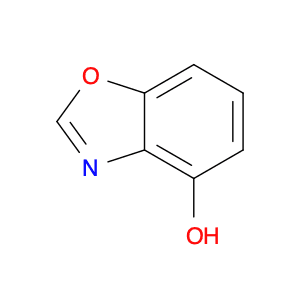
:1,3-benzoxazol-4-ol
Description:
1,3-Benzoxazol-4-ol is an organic compound characterized by its fused benzene and oxazole rings, featuring a hydroxyl group at the 4-position of the oxazole ring. This compound typically appears as a white to off-white solid and is soluble in polar solvents such as water and alcohols, owing to the presence of the hydroxyl group, which can engage in hydrogen bonding. It exhibits properties typical of both aromatic compounds and heterocycles, including stability and potential reactivity due to the electron-rich nature of the oxazole ring. 1,3-Benzoxazol-4-ol is of interest in various fields, including medicinal chemistry, due to its potential biological activities, such as antimicrobial and anti-inflammatory effects. Its structure allows for various functionalizations, making it a versatile building block in organic synthesis. Additionally, it may serve as a fluorescent probe or a ligand in coordination chemistry, highlighting its utility in both academic research and industrial applications. Safety data should be consulted for handling and usage, as with any chemical substance.
Formula:C7H5NO2
InChI:InChI=1/C7H5NO2/c9-5-2-1-3-6-7(5)8-4-10-6/h1-4,9H
SMILES:c1cc(c2c(c1)ocn2)O
Synonyms:- Benzooxazol-4-Ol
- 4-Benzoxazolol
- 1,3-Benzoxazol-4-ol
Sort by
Purity (%)
0
100
|
0
|
50
|
90
|
95
|
100
Found 4 products.
Benzooxazol-4-ol
CAS:Benzooxazol-4-ol is a ligand that binds to nitrogen atoms. It has coordination chemistry properties, including the ability to stabilize metal ions. This ligand is also able to form a stable carbonyl group, which is important for nucleophilic attacks on carbonyls and dioxetanes. Benzooxazol-4-ol has been shown to inhibit the formation of cell apoptosis by binding to neutrophils and stabilizing them in their active forms. It also inhibits liver disease by preventing trimethylsiloxy from forming and preventing the accumulation of mononuclear cells in the liver.
Formula:C7H5NO2Purity:Min. 95%Molecular weight:135.12 g/mol