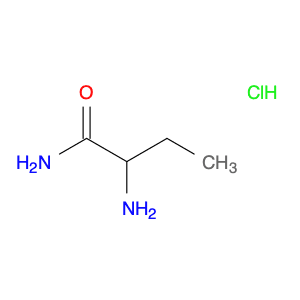
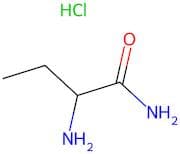
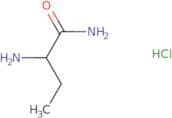
CAS 89603-48-5
:Butanamide, 2-amino-, monohydrochloride
Description:
Butanamide, 2-amino-, monohydrochloride, also known as 2-amino-N-butyramide hydrochloride, is an organic compound characterized by its amide functional group and an amino group attached to a butanamide backbone. This compound typically appears as a white crystalline solid and is soluble in water due to the presence of the hydrochloride salt, which enhances its solubility compared to the free base form. It has applications in various fields, including pharmaceuticals and biochemistry, often serving as an intermediate in the synthesis of more complex molecules. The presence of both the amine and amide functional groups allows for diverse reactivity, making it a valuable building block in organic synthesis. Additionally, its hydrochloride form can influence its stability and reactivity, particularly in biological systems. As with many amides, it may exhibit properties such as moderate melting points and specific interactions with other chemical species, which can be important in its applications. Safety data should be consulted for handling and usage, as with any chemical substance.
Formula:C4H10N2OClH
Synonyms:- 2-Aminobutanamide hydrochloride (1:1)
Sort by
Purity (%)
0
100
|
0
|
50
|
90
|
95
|
100
Found 4 products.
2-Aminobutanamide Hydrochloride
CAS:Formula:C4H11ClN2OPurity:95%Color and Shape:SolidMolecular weight:138.59592-Aminobutanamide hydrochloride
CAS:2-Aminobutanamide hydrochloridePurity:95%Molecular weight:138.60g/mol2-Aminobutanamide hydrochloride
CAS:2-Aminobutanamide hydrochloride (2AB) is a chemical compound that is used in the production of l-tartaric acid. It is industrially produced by dissolving 2-aminobutanoic acid in a solution of sodium hydroxide and then adding it to an aqueous solution of potassium chloride. The product precipitates as a salt, which can be purified by liquid chromatography. 2AB is unstable at high temperatures, so it must be stored under refrigeration. 2AB has virulent properties, which are attributed to its acidic nature and the fact that it reacts with chlorine to form hydrogen chloride gas. !--END-->Formula:C4H11ClN2OPurity:Min. 95%Molecular weight:138.59 g/mol