CAS 89966-72-3
:4-chloro-6-ethyl-2-methyl-pyrimidine
Description:
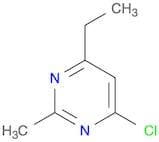
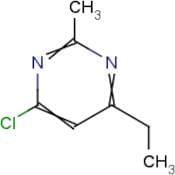
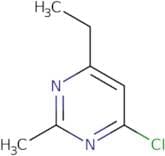
4-Chloro-6-ethyl-2-methyl-pyrimidine is a heterocyclic organic compound characterized by a pyrimidine ring, which is a six-membered aromatic ring containing two nitrogen atoms at positions 1 and 3. This compound features a chloro substituent at the 4-position, an ethyl group at the 6-position, and a methyl group at the 2-position of the pyrimidine ring. Its molecular structure contributes to its potential applications in pharmaceuticals and agrochemicals, as pyrimidine derivatives are known for their biological activity. The presence of halogen and alkyl substituents can influence the compound's reactivity, solubility, and interaction with biological targets. Typically, compounds like this may exhibit properties such as moderate to low solubility in water, but higher solubility in organic solvents. Additionally, the compound's stability and reactivity can be affected by the electronic effects of the substituents. Overall, 4-chloro-6-ethyl-2-methyl-pyrimidine is of interest in synthetic chemistry and medicinal chemistry due to its structural features and potential utility.
Formula:C7H9ClN2
InChI:InChI=1/C7H9ClN2/c1-3-6-4-7(8)10-5(2)9-6/h4H,3H2,1-2H3
SMILES:CCc1cc(Cl)nc(C)n1
Synonyms:- 4-Chloro-6-Ethyl-2-Methylpyrimidine
- Pyrimidine, 4-Chloro-6-Ethyl-2-Methyl-
- 4-Chloro-6-ethyl-2-methylpyrimidine95%
- 4-CHLORO-6-ETHYL-2-METHYLPYRIMIDINE ISO 9001:2015 REACH
- 4-chloro-6-ethyl-2-methylpyrimidine(SALTDATA: FREE)
- 4-CHLORO-6-ETHYL-2-METHYLPYRIMIDINE 95%
Sort by
Purity (%)
0
100
|
0
|
50
|
90
|
95
|
100
Found 4 products.
4-Chloro-6-ethyl-2-methylpyrimidine
CAS:Formula:C7H9ClN2Purity:98%Color and Shape:LiquidMolecular weight:156.61284-Chloro-6-ethyl-2-methylpyrimidine
CAS:4-Chloro-6-ethyl-2-methylpyrimidinePurity:95%Molecular weight:156.61g/mol4-Chloro-6-ethyl-2-methylpyrimidine
CAS:Formula:C7H9ClN2Purity:95.0%Color and Shape:SolidMolecular weight:156.614-Chloro-6-ethyl-2-methylpyrimidine
CAS:4-Chloro-6-ethyl-2-methylpyrimidine is an acidic chloride that can be used as a reagent to form ketoximes and phosphoryl. It is also used to make selenium, pyrimidinyl, and nitrite. This compound has been shown to react with propyl nitrosates in the presence of a base to form yields of pyrimidinyl nitrites. The reaction is catalyzed by phosphoryl chloride.Formula:C7H9ClN2Purity:Min. 95%Molecular weight:156.61 g/mol