CAS 90-59-5
:3,5-Dibromosalicylaldehyde
Description:
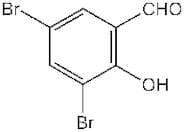
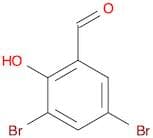
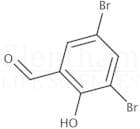
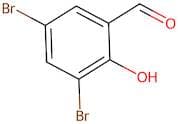
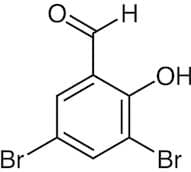
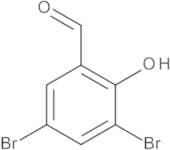
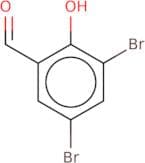
3,5-Dibromosalicylaldehyde is an organic compound characterized by its aromatic structure, featuring both bromine substituents and an aldehyde functional group. It is derived from salicylic acid, where two bromine atoms are positioned at the 3 and 5 positions of the aromatic ring, while the aldehyde group is located at the 1 position. This compound typically appears as a pale yellow solid and is known for its moderate solubility in organic solvents such as ethanol and ether, but limited solubility in water. 3,5-Dibromosalicylaldehyde exhibits reactivity typical of aldehydes, including the ability to undergo oxidation and condensation reactions. Its bromine substituents can also participate in electrophilic aromatic substitution reactions, making it a useful intermediate in organic synthesis. Additionally, this compound may exhibit biological activity, which has led to interest in its potential applications in pharmaceuticals and agrochemicals. Proper handling and storage are essential due to its potential toxicity and environmental impact.
Formula:C7H4Br2O2
InChI:InChI=1/C7H4Br2O2/c8-5-1-4(3-10)7(11)6(9)2-5/h1-3,11H
InChI key:InChIKey=JHZOXYGFQMROFJ-UHFFFAOYSA-N
SMILES:C(=O)C1=C(O)C(Br)=CC(Br)=C1
Synonyms:- 1-Formyl-2-hydroxy-3,5-dibromobenzene
- 2,4-Dibromo-6-formylphenol
- 2-Hydroxy-3,5-dibromobenzaldehyde
- 3,5-Dibromo-2-hydroxybenzaldehyde
- 3,5-Dibromosalicyladehyde
- 4,6-Dibromo-2-formylphenol
- Benzaldehyde, 3,5-dibromo-2-hydroxy-
- Dalyde
- NSC 6221
- Salicylaldehyde, 3,5-dibromo-
- 3,5-Dibromosalicylaldehyde
- AKOS BBS-00003256
- AKOS B028985
- 3,5-dibromo-2-hydroxy-benzaldehyd
- SALOR-INT L497649-1EA
- LABOTEST-BB LT00137784
- 3,5-DIBROMOSILICYLALDEHYDE
- OTAVA-BB BB7018801957
- See more synonyms
Sort by
Purity (%)
0
100
|
0
|
50
|
90
|
95
|
100
Found 8 products.
3,5-Dibromosalicylaldehyde, 98%
CAS:3,5-Dibromosalicylaldehyde reacts with alkyl cyanoacetates in the presence of ammonium acetate to yield 4H- chromenes. It can be used in the synthesis of Schiff base and can be used as reactant for synthesis of Schiff base ligands which forms mononuclear complexes with copper(II), nickel(II), zinc(IFormula:C7H4Br2O2Purity:98%Color and Shape:Pale yellow, Crystals or powder or crystalline powder or fused solidMolecular weight:279.923,5-Dibromosalicylaldehyde
CAS:Formula:C7H4Br2O2Purity:96%Color and Shape:SolidMolecular weight:279.91353,5-dibromo-2-hydroxybenzaldehyde
CAS:3,5-dibromo-2-hydroxybenzaldehydeFormula:C7H4Br2O2Purity:98%Color and Shape: off-white to faint beige powderMolecular weight:279.91346g/mol3,5-Dibromosalicylaldehyde
CAS:Formula:C7H4Br2O2Purity:>98.0%(T)(HPLC)Color and Shape:White to Orange to Green powder to crystalineMolecular weight:279.92Dembrexine EP Impurity C
CAS:Controlled ProductFormula:C7H4Br2O2Color and Shape:NeatMolecular weight:279.913,5-Dibromosalicylaldehyde
CAS:3,5-Dibromosalicylaldehyde is a copper complex that has been synthesized from 3,5-dibromosalicylaldehyde and copper chloride. FTIR spectroscopy revealed that the coordination geometry of the copper complex is octahedral with two nitrogen atoms in the equatorial plane. The presence of hydrogen bonding interactions was confirmed by homologous protein adsorption experiments. This chemical structure was determined using X-ray crystallography and fluorescence probe experiments. The copper complex showed high affinity for malonic acid, which is an ester hydrochloride. The molecular mechanism of this interaction is based on adsorption, which occurs through hydrogen bonding interactions and hydrophobic interactions. Structural analysis revealed that the polymeric matrix consists of a three-dimensional network of crosslinked chains, while FTIR analysis indicated a possible disulfide bond between two cysteine residues.Formula:C7H4Br2O2Purity:Min. 95%Color and Shape:Yellow PowderMolecular weight:279.91 g/mol3,5-Dibromosalicylaldehyde
CAS:Formula:C7H4Br2O2Purity:95%Color and Shape:Solid, PowderMolecular weight:279.915