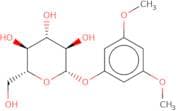
CAS 90-71-1
:alpha-(3,5-dimethoxyphenyl)-beta-D-glucopyranoside
Description:
Alpha-(3,5-dimethoxyphenyl)-beta-D-glucopyranoside, also known by its CAS number 90-71-1, is a glycoside compound characterized by the presence of a glucose moiety linked to a 3,5-dimethoxyphenyl group. This compound typically exhibits a white to off-white crystalline appearance and is soluble in polar solvents such as water and methanol, reflecting its glycosidic nature. The methoxy groups on the phenyl ring contribute to its hydrophobic characteristics, influencing its solubility and reactivity. It is often studied for its potential biological activities, including antioxidant and anti-inflammatory properties, which may be attributed to the phenolic structure. The glycosidic bond in this compound makes it stable under neutral conditions but susceptible to hydrolysis in acidic or enzymatic environments, leading to the release of the aglycone and glucose. Overall, alpha-(3,5-dimethoxyphenyl)-beta-D-glucopyranoside serves as an interesting subject in both synthetic and medicinal chemistry due to its structural features and potential applications.
Formula:C14H20O8
InChI:InChI=1/C14H20O8/c1-19-7-3-8(20-2)5-9(4-7)21-14-13(18)12(17)11(16)10(6-15)22-14/h3-5,10-18H,6H2,1-2H3/t10-,11-,12+,13-,14+/m1/s1
Synonyms:- Taxicatin
Sort by
Purity (%)
0
100
|
0
|
50
|
90
|
95
|
100
Found 1 products.
Taxicatin
CAS:Taxicatin is a secondary metabolite, which is a plant-derived alkaloid with significant pharmacological activity. It is sourced from a specific species of plant known for its bioactive compounds, often found within the tropics. The mode of action of Taxicatin involves the disruption of critical cellular processes, including the inhibition of microtubule assembly during cell division, which ultimately leads to apoptosis in rapidly dividing cells. This makes it a potent candidate for research into anticancer therapies. Taxicatin's uses and applications are primarily in the area of oncology, where its efficacy in interfering with malignant cell proliferation is being rigorously evaluated. Furthermore, its role as a template in drug design and development is of considerable interest, owing to its unique structural characteristics that can be utilized to synthesize novel compounds with improved therapeutic indices. Research is ongoing to explore the full spectrum of its biochemical interactions and potential synergistic effects when combined with other therapeutic agents.Formula:C14H20O8Purity:Min. 95%Color and Shape:PowderMolecular weight:316.3 g/mol