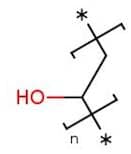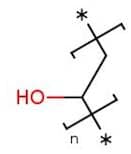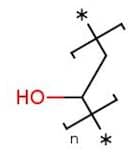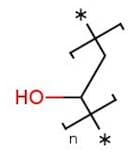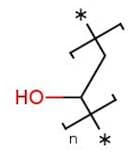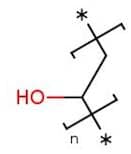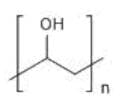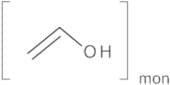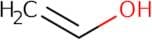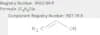
CAS 9002-89-5
:Poly(vinyl alcohol)
Description:
Poly(vinyl alcohol) (PVA) is a synthetic polymer characterized by its water-solubility, biocompatibility, and film-forming properties. It is produced through the hydrolysis of poly(vinyl acetate) and is known for its excellent adhesion, flexibility, and resistance to oils and greases. PVA is typically used in various applications, including adhesives, coatings, and films, due to its ability to form strong hydrogen bonds with water molecules, which enhances its solubility. The degree of hydrolysis and molecular weight can significantly influence its properties, such as viscosity and mechanical strength. PVA is also biodegradable, making it an environmentally friendly option in many applications. Additionally, it exhibits good thermal stability and can be modified to enhance its properties for specific uses, such as in biomedical applications or as a component in composite materials. Overall, PVA is a versatile polymer with a wide range of industrial and commercial applications.
Formula:(C2H4O)x
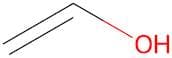
InChI:InChI=1S/C2H4O/c1-2-3/h2-3H,1H2
InChI key:InChIKey=IMROMDMJAWUWLK-UHFFFAOYSA-N
SMILES:C(=C)O
Synonyms:- 100-27H
- 100-37H
- 100-40H
- 1799S
- 1R2110
- 22-99H
- 9P75R
- 9X75Rs
- 9X75Sr
- Alvyl
- Bijam+
- Bovlon
- CST
- Claria
- Clinicel
- Covol
- Duslo
- Elvanol
- Fiberol
- Fibrilbond
- Fsam-H
- Gelutol
- Gelvatol
- Gh-Jy
- Gohsenol
- Kuragel
- Lemol
- LentiKats
- Liquifilm
- Merocel
- Microbreath
- Mowibase
- Mowiol
- PPL
- PVA
- PVS
- Polydesis
- Polyvinol
- Polyvinylalkohol
- Polyviol
- Poval
- PualCob
- Pva-Cst
- Pva-Ec
- Pva-H
- Pva-Hc
- Pva-Ld
- Pva-Sm
- Pva-Sn
- Pva-Uv
- Pvoh
- Px-CVG
- Px-CVR
- Rhodoviol
- SI
- TTF
- Vf-Hp
- Vf-Lh
- Vf-Pm
- Vf-Ps
- Vf-Px
- Vf-Xh
- Vf-Xs
- Vinalak
- Vinarol
- Vinol
- Wash-A-Way
- Winacol
- Lemol 5-98
- Vinyl alcohol, polymers
- Lemol 5-88
- Ethenol, homopolymer
- See more synonyms
Sort by
Purity (%)
0
100
|
0
|
50
|
90
|
95
|
100
Poly(vinyl Alcohol) (n=approx. 2000) (degree of saponification ca. 80mol%)
CAS:Color and Shape:White to Light yellow powder to crystalPolyvinyl alcohol, 86-89% hydrolyzed, low molecular weight
CAS:Polyvinyl alcohol is used as a biological reagent to test the dispersion of zinc oxide nanoparticles. It is an effective protein resistant material and is used to stabilize gold colloids of diameter 3-8nm. It is used as an emulsion polymerization aid to make polyvinyl acetate, as a protective colloiFormula:(C2H4O)nPurity:86-89%Color and Shape:White to pale yellow, Granular powderPolyvinyl alcohol, 86-89% hydrolyzed, medium molecular weight
CAS:Polyvinyl alcohol is used as a biological reagent to test the dispersion of zinc oxide nanoparticles. It is an effective protein resistant material and is used to stabilize gold colloids of diameter 3-8nm. It is used as an emulsion polymerization aid to make polyvinyl acetate, as a protective colloiFormula:(C2H4O)nPurity:86-89%Color and Shape:White to off-white, PowderPolyvinyl alcohol, 98-99% hydrolyzed, low molecular weight
CAS:Polyvinyl alcohol is used as a biological reagent to test the dispersion of zinc oxide nanoparticles. It is an effective protein resistant material and is used to stabilize gold colloids of diameter 3-8nm. It is used as an emulsion polymerization aid to make polyvinyl acetate, as a protective colloiFormula:(C2H4O)nPurity:98-99%Color and Shape:Granular powder, WhitePolyvinyl alcohol, 98-99% hydrolyzed, high molecular weight
CAS:Polyvinyl alcohol is used in food industries as a binding and coating agent. Its viscosity favors the application as coating agent to tablets and capsules. Mixed-matrix membrane prepared by dispersion of NaA zeolite particles is used to study the pervaporative separation of water-butanol mixtures.Formula:(C2H4O)nPurity:98-99%Color and Shape:Granular powder, Pale creamPolyvinyl alcohol, 87-89% hydrolyzed, high molecular weight
CAS:Polyvinyl alcohol is used as a biological reagent to test the dispersion of zinc oxide nanoparticles. It is an effective protein resistant material and is used to stabilize gold colloids of diameter 3-8nm. It is used as an emulsion polymerization aid to make polyvinyl acetate, as a protective colloiFormula:(C2H4O)nPurity:87-89%Color and Shape:White to off-white, Powder or crystals or crystalline powder or granulesPolyvinyl alcohol, 98-99% hydrolyzed, medium molecular weight
CAS:Polyvinyl alcohol is used in papermaking, textiles, and in a variety of coatings. It is used as an emulsion polymerization aid to make polyvinyl acetate, as a protective colloid, as a film used in the water transfer printing process, as a surfactant for the formation of polymer encapsulated nanobeadFormula:(C2H4O)nPurity:98-99%Color and Shape:Powder, Whit to off-white to creamPolyvinyl Alcohol
CAS:Polyvinyl alcohols, whether or not containing unhydrolyzed acetate groupsFormula:H(C2H4O)m(C4H6O2)nHColor and Shape:PowderMolecular weight:46.0684Polyvinyl Alcohol (PVA)
CAS:Formula:C2H4OnColor and Shape:White To Off-White SolidMolecular weight:86000 (average)Poly Vinyl Alcohol
CAS:Polyvinyl alcohol: water-soluble, biodegradable polymer; used for biomedical applications and medical excipients.Formula:(C2H4O)nPurity:98%Color and Shape:SolidMolecular weight:30000-70000 (Average)Polyvinyl Alcohol
CAS:Controlled ProductApplications Polyvinyl Alcohol is a useful research chemical. Polyvinyl Alcohol/ZnS composite films are used as nanocatalyst for organ dye degradation.
References Khan, R., et al.: ACS Omega, 4, 6144 (2019)Formula:(C2H4O)nColor and Shape:NeatMolecular weight:44.05Polyvinyl alcohol,Mw~67,000
CAS:Polyvinyl alcohol is a polymer that is used as a coating material, adhesive, and in the manufacture of certain plastics. It has been shown to have anti-inflammatory properties and may be effective for bowel disease. Polyvinyl alcohol can be prepared by hydrolysis of polyvinyl acetate using sodium carbonate or zirconium oxide as catalysts. The enzyme activities of polyvinyl alcohol are dependent on the molecular weight, which is usually between 67,000 and 1 million. Polyvinyl alcohol can be manufactured by esterification of vinyl acetate with anhydrous ethanol followed by hydrolysis with sodium hydroxide. It has also been shown to inhibit bacterial growth by forming hydrogen bonds with the bacterial cell wall.Formula:(C2H4O)xPurity:Min. 95%Color and Shape:PowderPoly(vinyl alcohol), average Mw 150,000 - 200,000
CAS:Please enquire for more information about Poly(vinyl alcohol), average Mw 150,000 – 200,000 including the price, delivery time and more detailed product information at the technical inquiry form on this page
Formula:(C2H4O)xPurity:(Hydrolysis) 98.0 To 99.9 Mol-%Polyvinyl alcohol - Mw 67,300 - 90,000
CAS:Polyvinyl alcohol is a water-soluble polymer that can be synthesized by the hydrolysis of polyvinyl acetate. It has been used as a model system to study the reaction mechanism and enzymatic activity of polyvinyl alcohol. The hydrolysis of polyvinyl acetate yields vinyl acetate, which then reacts with water to form polyvinyl alcohol. Polyvinyl alcohol can be synthesized by the addition of benzalkonium chloride or x-ray diffraction data. Polyvinyl alcohol is also present in many autoimmune diseases, such as lupus erythematosus. It is often used for wound dressings due to its ability to absorb fluids and promote healing. Polyvinyl alcohols are also used in laser ablation because they do not burn easily and are low cost.Formula:C2H4OnPurity:(Hydrolysis) 98.0 To 99.9 Mol-%Color and Shape:Powder