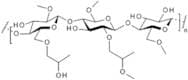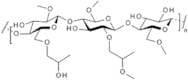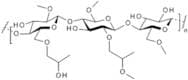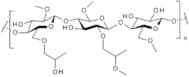
CAS 9004-64-2
:Cellulose, 2-hydroxypropyl ether
Description:
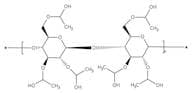
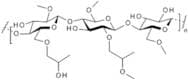
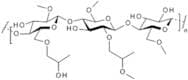
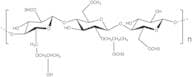
Cellulose, 2-hydroxypropyl ether, commonly referred to as hydroxypropyl cellulose (HPC), is a non-ionic, water-soluble derivative of cellulose. It is produced by the etherification of cellulose with propylene oxide, resulting in the introduction of hydroxypropyl groups into the cellulose structure. This modification enhances its solubility in water and organic solvents, making it useful in various applications. HPC is characterized by its ability to form clear, viscous solutions, which makes it valuable as a thickening agent, film-forming agent, and stabilizer in pharmaceuticals, cosmetics, and food products. It is also known for its biocompatibility and low toxicity, which further broadens its applicability in biomedical fields. Additionally, hydroxypropyl cellulose exhibits thermoplastic properties, allowing it to be processed in various forms. Its chemical stability and resistance to degradation under normal conditions contribute to its longevity in formulations. Overall, HPC is a versatile polymer with significant utility across multiple industries due to its unique properties.
Formula:C3H7O
InChI:InChI=1/C36H70O19/c1-19(37)9-45-17-27-29(47-11-21(3)39)31(48-12-22(4)40)34(51-15-25(7)43)36(54-27)55-30-28(18-46-10-20(2)38)53-35(52-16-26(8)44)33(50-14-24(6)42)32(30)49-13-23(5)41/h19-44H,9-18H2,1-8H3/t19?,20?,21?,22?,23?,24?,25?,26?,27?,28?,29?,30-,31?,32?,33?,34?,35?,36+/m1/s1
Synonyms:- AeroWhip
- HPC
- Hpc-E
- Hpc-Ef
- Hpc-Ef-G
- Hpc-H
- Hpc-Hf
- Hpc-L
- Hpc-L-Fp
- Hpc-Le-G
- Hpc-Lg
- Hpc-Ll
- Hpc-Lr
- Hpc-M
- Hpc-Mf
- Hpc-Mg
- Hpc-S
- Hpc-Sfp
- Hpc-Sl
- Hpc-Ssl
- Hpc-Ssl-Sfp
- Hydroxypropylcellulose
- Hyprolose
- Klucel
- L-Hpc
- Lacrisert
- Leogard
- O-(2-Hydroxypropyl)cellulose
- O-(Hydroxypropyl)cellulose
- Hydroxypropyl cellulose
- Cellulose hydroxypropyl ether
- Oxypropylated cellulose
- Hydroxypropyl ether of cellulose
- 1-[(5R)-3,4-bis(2-hydroxypropoxy)-6-(2-hydroxypropoxymethyl)-5-[(2S)-3,4,5-tris(2-hydroxypropoxy)-6-(2-hydroxypropoxymethyl)tetrahydropyran-2-yl]oxy-tetrahydropyran-2-yl]oxypropan-2-ol
- Hydroxypropyl cellulose, Average M.W. 100.000
- Cellulose, 2-hydroxypropyl ether
- Hydroxypropyl Cellulose (6-10mPa.s, 2% in Water at 20deg C)
- (HYDROXYPROPYL)CELLULOSE STANDARD 15'000
- HYDROXYPROPYLCELLULOSE,150-400CPS,NF
- Hydroxypropyl cellulose USP
- HYDROXYPROPYL CELLULOSE LOW-SUBSTITUTED
- syntheticvegetablegums
- low substituted hydroxypropyl cellulose(LH21)
- Hydroxypropyl Cellulose (500 mg)
- HYDROXYPROPYL CELLULOSE 6-10.0
- HYDROXYPROPYL CELLULOSE, 1000-4000 MPAS
- Hydroxypropyl Cellulose (1,000-4,000mPa.s, 2% in Water at 20deg C)
- cellulosehydroxypropylether
- HYDROXYPROPYL CELLULOSE, 150-400 MPAS
- HYDROXYPROPYL CELLULOSE, M.W. 1,000,000
- HYDROXYPROPYL CELLULOSE, AVERAGE MW. CA. 80,000
- hydroxypropyletherofcellulose
- Hydroxypropyl cellulose average Mw ~80,000, average Mn ~10,000, powder, 20 Mesh particle size (99% through)
- Hydroxypropyl Cellulose (200 mg)
- HPC, hydroxypropyl cellulose
- pm50(polymer)
- HYDROXYPROPYL CELLULOSE, 3-6CPS
- (HYDROXYPROPYL)CELLULOSE STANDARD 50'000
- HYDROXYPROPYL CELLULOSE, 3-6CPS: (2% IN WATER AT 20C)
- oxypropylatedcellulose
- HYDROXYPROPYLCELLULOSE,4,000-6,500CPS,NF
- HYDROXYPROPYL CELLULOSE, M.W. 370,000
- HYDROXYPROPYL CELLULOSE 2-2.9
- synthetic
- Hydroxypropyl cellulose, Average M.W. 100.000 250GR
- HYDROXYPROPYLCELLULOSE,75-100CPS,NF
- (HYDROXYPROPYL)CELLULOSE STANDARD 35'000
- HYDROXYPROPYL CELLULOSE, 6-10 MPAS
- Hydroxypropyl Cellulose (3-6mPa.s, 2% in Water at 20deg C)
- HYDROXYPROPYLCELLULOSE, M.W.60,000
- (HYDROXYPROPYL)CELLULOSE STANDARD 25'000
- (2% IN WATER AT 20)
- (HYDROXYPROPYL)CELLULOSE STANDARD 30'000
- Hydroxypropyl cellulose, Average M.W. 100.000 100GR
- Hydroxypropyl cellulose average Mw ~370,000, powder, 20 Mesh particle size (99% through)
- 2-Hydroxypropyl cellulose
- (HYDROXYPROPYL)CELLULOSE STANDARD 10'000
- Hydroxypropyl cellulose average Mw ~100,000, powder, 20 Mesh particle size (99% through)
- pm50
- L-Hydroxypropylcellulose
- HYDROXYPROPYL CELLULOSE, M.W. 100,000
- Hydroxypropyl Cellulose (150-400mPa.s, 2% in Water at 20deg C)
- Low-Substituted Hydroxypropyl cellulose
- Hydroxypropyl cellulose average Mw ~1,000,000, powder, 20 mesh particle size (99% through)
- (HYDROXYPROPYL)CELLULOSE STANDARD 20'000
- Ve(VitaminEAcetateOil
- hydroxypropyl
- HYDROXYPROPYL CELLULOSE 3-5.9
- HYDROXYPROPYL CELLULOSE, 3-5.9 MPAS
- See more synonyms
Sort by
Purity (%)
0
100
|
0
|
50
|
90
|
95
|
100
Found 25 products.
Hydroxypropyl Cellulose (150-400mPa·s, 2% in Water at 20°C)
CAS:Color and Shape:White to Almost white powder to crystalHydroxypropyl Cellulose (6-10mPa·s, 2% in Water at 20°C)
CAS:Color and Shape:White to Almost white powder to crystalHydroxypropyl Cellulose (3-6mPa·s, 2% in Water at 20°C)
CAS:Color and Shape:White to Almost white powder to crystalHydroxypropyl Cellulose (1000-4000mPa·s, 2% in Water at 20°C)
CAS:Color and Shape:White to Almost white powder to crystalHydroxypropyl cellulose, M.W. 100,000
CAS:<p>Thickener, binder, and emulsifier</p>Color and Shape:Powder, White to off-whiteHydroxypropyl Cellulose
CAS:<p>Cellulose ethers,nesoi</p>Formula:C3H8O2·xUnspecifiedColor and Shape:White Cream Powder GranularMolecular weight:209.2417Low-substituted Hydroxypropyl Cellulose
CAS:<p>Cellulose ethers,nesoi</p>Formula:C11H15NO3Color and Shape:White Off-White PowderMolecular weight:209.2417Hydroxypropyl cellulose, low-substituted
CAS:Color and Shape:White to off-white powderMolecular weight:-Hydroxypropyl Cellulose
CAS:<p>Hydroxypropyl cellulose (HPC), soluble in water and organics, serves as a food additive and DNA separation aid.</p>Formula:C12H20N2Purity:98%Color and Shape:SolidMolecular weight:192.306Hydroxypropyl cellulose - Average MW 50,000 - 1250,000
CAS:<p>In water, hydroxypropyl cellulose forms liquid crystals with many mesophases depending on concentration. These mesophases include isotropic, anisotropic, nematic and cholesteric, the latter resulting in many colors such as violet, green and red. Pharmaceutical applications include treatments for medical conditions such as dry eye syndrome (keratoconjunctivitis sicca), recurrent corneal erosions, decreased corneal sensitivity, exposure and neuroparalytic keratitis. It is also used as a binder in tablets. Hydroxypropylcellulose is also used as a thickener, a binder and emulsion stabiliser in foods with E number E463. HPC is used as a support matrix for DNA separations by capillary and microchip electrophoresis.</p>Purity:Min. 95%Color and Shape:Clear LiquidHydroxypropyl cellulose - Average MW 370,000
CAS:<p>In water, hydroxypropyl cellulose forms liquid crystals with many mesophases depending on concentration. These mesophases include isotropic, anisotropic, nematic and cholesteric, the latter resulting in many colors such as violet, green and red. Pharmaceutical applications include treatments for medical conditions such as dry eye syndrome (keratoconjunctivitis sicca), recurrent corneal erosions, decreased corneal sensitivity, exposure and neuroparalytic keratitis. It is also used as a binder in tablets. Hydroxypropylcellulose is also used as a thickener, a binder and emulsion stabiliser in foods with E number E463. HPC is used as a support matrix for DNA separations by capillary and microchip electrophoresis.</p>Purity:Min. 95%Color and Shape:PowderHydroxypropyl cellulose - Average MW 150,000
CAS:<p>In water, hydroxypropyl cellulose forms liquid crystals with many mesophases depending on concentration. These mesophases include isotropic, anisotropic, nematic and cholesteric, the latter resulting in many colors such as violet, green and red. Pharmaceutical applications include treatments for medical conditions such as dry eye syndrome (keratoconjunctivitis sicca), recurrent corneal erosions, decreased corneal sensitivity, exposure and neuroparalytic keratitis. It is also used as a binder in tablets. Hydroxypropylcellulose is also used as a thickener, a binder and emulsion stabiliser in foods with E number E463. HPC is used as a support matrix for DNA separations by capillary and microchip electrophoresis.</p>Hydroxypropyl cellulose - Average MW 80,000
CAS:<p>In water, hydroxypropyl cellulose forms liquid crystals with many mesophases depending on concentration. These mesophases include isotropic, anisotropic, nematic and cholesteric, the latter resulting in many colors such as violet, green and red. Pharmaceutical applications include treatments for medical conditions such as dry eye syndrome (keratoconjunctivitis sicca), recurrent corneal erosions, decreased corneal sensitivity, exposure and neuroparalytic keratitis. It is also used as a binder in tablets. Hydroxypropylcellulose is also used as a thickener, a binder and emulsion stabiliser in foods with E number E463. HPC is used as a support matrix for DNA separations by capillary and microchip electrophoresis.</p>Purity:Min. 95%Hydroxypropyl Cellulose
CAS:Controlled Product<p>Applications Hydroxypropyl Cellulose is used in the synthesis of nanoparticle carriers for drug delivery.<br>References Watanabe, Y. et al.: Biol. Pharm. Bull., 18, 1308 (1995); Ober, C. et al.: J. Polym. Sci., 23, 103 (1985); Lok, K. et al.: Can. J. Chem., 63, 209 (1985);<br></p>Formula:C6H8N2O5Color and Shape:NeatMolecular weight:0.00Hydroxypropyl cellulose - Average MW 1,000,000
CAS:<p>Binder in tablets; food additive; has several pharmaceutical applications</p>Purity:Min. 95%Hydroxypropyl cellulose - Average MW 100,000
CAS:<p>In water, hydroxypropyl cellulose forms liquid crystals with many mesophases depending on concentration. These mesophases include isotropic, anisotropic, nematic and cholesteric, the latter resulting in many colors such as violet, green and red. Pharmaceutical applications include treatments for medical conditions such as dry eye syndrome (keratoconjunctivitis sicca), recurrent corneal erosions, decreased corneal sensitivity, exposure and neuroparalytic keratitis. It is also used as a binder in tablets. Hydroxypropylcellulose is also used as a thickener, a binder and emulsion stabiliser in foods with E number E463. HPC is used as a support matrix for DNA separations by capillary and microchip electrophoresis.</p>Purity:Min. 95%Low-Substituted hydroxypropylcellulose
CAS:<p>LH 21 is a low-substituted hydroxypropylcellulose. It is produced by the fluorination of cellulose, followed by substitution with a variety of monosaccharides and oligosaccharides to produce a complex carbohydrate. LH 21 is synthesized for custom needs, glycosylated, methylated, and modified at the sugar level with click chemistry. It has a CAS No. 9004-64-2 and is Carbohydrate in nature. LH 21 has high purity and can be used in many applications including as an excipient or additive in pharmaceutical formulations.</p>Purity:Min. 95%Color and Shape:PowderHydroxypropyl cellulose - Average MW 200,000
CAS:<p>In water, hydroxypropyl cellulose forms liquid crystals with many mesophases depending on concentration. These mesophases include isotropic, anisotropic, nematic and cholesteric, the latter resulting in many colors such as violet, green and red. Pharmaceutical applications include treatments for medical conditions such as dry eye syndrome (keratoconjunctivitis sicca), recurrent corneal erosions, decreased corneal sensitivity, exposure and neuroparalytic keratitis. It is also used as a binder in tablets. Hydroxypropylcellulose is also used as a thickener, a binder and emulsion stabiliser in foods with E number E463. HPC is used as a support matrix for DNA separations by capillary and microchip electrophoresis.</p>Color and Shape:Powder