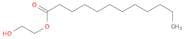
CAS 9004-81-3
:Polyethylene glycol monolaurate
Description:
Polyethylene glycol monolaurate, with the CAS number 9004-81-3, is a non-ionic surfactant derived from the esterification of polyethylene glycol and lauric acid. This compound is characterized by its amphiphilic nature, possessing both hydrophilic (water-attracting) and hydrophobic (water-repelling) properties, which makes it effective in reducing surface tension and stabilizing emulsions. It is typically a white to off-white solid or viscous liquid, depending on its molecular weight and formulation. Polyethylene glycol monolaurate is soluble in water and various organic solvents, making it versatile for use in pharmaceuticals, cosmetics, and food products. Its applications include acting as an emulsifier, solubilizer, and stabilizer in formulations. Additionally, it is known for its mildness and low toxicity, which enhances its suitability for use in personal care products. Overall, polyethylene glycol monolaurate is valued for its functional properties and safety profile in various industrial and consumer applications.
Formula:(C2H4O)nC12H24O2
InChI:InChI=1S/C14H28O3/c1-2-3-4-5-6-7-8-9-10-11-14(16)17-13-12-15/h15H,2-13H2,1H3
InChI key:InChIKey=CTXGTHVAWRBISV-UHFFFAOYSA-N
SMILES:C(CC(OCCO)=O)CCCCCCCCC
Synonyms:- Nonex 27
- Poly(oxy-1,2-ethanediyl), α-(1-oxododecyl)-ω-hydroxy-
- Glycols, polyethylene, monolaurate
- Lauric acid, monoester with polyethylene glycol
- Nonex 31
Sort by
Purity (%)
0
100
|
0
|
50
|
90
|
95
|
100
Found 6 products.
Polyethylene Glycol Monolaurate (n=approx. 10)
CAS:Formula:HO(CH2CH2O)nOC(CH2)10CH3Color and Shape:Colorless - Slightly Pale Yellow LiquidPolyethylene Glycol 1000 Monolaurate
CAS:Formula:C14H28O3Purity:95%Color and Shape:LiquidMolecular weight:244.3703Ref: 54-OR1014764
10lTo inquire5mlTo inquire2.5lTo inquire25mlTo inquire500gTo inquire100mlTo inquire500mlTo inquirePoly(ethylene glycol) monolaurate,average Mn ~400
CAS:Poly(ethylene glycol) monolaurate is a polymeric compound that is used as an excipient in pharmaceutical preparations. It can be made by the reaction of ethylene diamine and fatty acids, where the composition of the fatty acid determines its biophysical properties such as morphology and formation rate. Poly(ethylene glycol) monolaurate has been shown to have a high rate of cell lysis, which may be due to its hydroxyl group or glycol ester functional group. It has also been shown to have anti-inflammatory effects in animal models.
Formula:C14H28O3Purity:Min. 95%Color and Shape:Clear LiquidMolecular weight:244.37 g/molRef: 3D-FP180380
Discontinued product