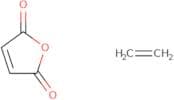
CAS 9006-26-2
:Ethylene-maleic anhydride copolymer
Description:
Ethylene-maleic anhydride copolymer (EMA) is a thermoplastic polymer characterized by its unique combination of properties derived from its constituent monomers, ethylene and maleic anhydride. This copolymer typically exhibits good adhesion, flexibility, and chemical resistance, making it suitable for various applications, including coatings, adhesives, and films. The presence of maleic anhydride introduces polar functional groups, enhancing the copolymer's compatibility with polar materials and improving its ability to bond with other substances. EMA is also known for its thermal stability and can be processed using standard thermoplastic techniques. Additionally, it can be modified to enhance its properties further, such as increasing its hydrophilicity or improving its mechanical strength. Due to its versatility, EMA is utilized in industries ranging from packaging to automotive and electronics, where it serves as a key component in formulations requiring durability and performance. Overall, the unique characteristics of ethylene-maleic anhydride copolymer make it a valuable material in various industrial applications.
Formula:(C4H2O3·C2H4)x
InChI:InChI=1S/C4H2O3.C2H4/c5-3-1-2-4(6)7-3;1-2/h1-2H;1-2H2
InChI key:InChIKey=YYXLGGIKSIZHSF-UHFFFAOYSA-N
SMILES:O=C1OC(=O)C=C1.C=C
Synonyms:- 2,5-Furandione, polymer with ethene
- 3-Oxabicyclo[3.2.0]Hept-1(5)-Ene-2,4-Dione
- A-C 1221P
- A-C 1302P
- Ac 573
- Ac 573P
- Ac 575
- Admer 207
- Admer AT 1804
- Admer F 551
- Anhydride maleique polymerise avec l'ethylene
- Bondine HX 0210
- Cel-Span 334
- Ceramer 106
- Coesive L 8.92.8m
- Copolymer, Ethylene-Maleic Anhydride
- Dx 840
- Dx 840-11
- Eb 02B
- Ema 11
- Ema 1605
- Ema 21
- Ema 31
- Ema 61
- Ema 64K
- Ema 701
- Ema 71
- Ema 81
- Ema 91
- Emi 31
- Ethene, polymer with 2,5-furandione
- Ethene-maleic anhydride copolymer
- Ethylene maleic anhydride co-polymer
- Ethylene, polymer with maleic anhydride
- Ethylene-maleic acid anhydride copolymer
- Ethylene-maleic anhydride copolymer
- Ethylene-maleic anhydride polymer
- Ethylene/MA copolymer
- F 551
- Flexomer DEFB 1373
- Furan-2,5-Dione - Ethene (1:1)
- Fusabond M 603
- Fusabond M 623XF
- Lotader HX 807.0
- M 503
- Maleated polyethylene
- Maleic anhydride ethene polymer
- Maleic anhydride polymer w/ethane
- Maleic anhydride, polymer with ethylene
- Maleic anhydride-ethylene copolymer
- Maleic anhydride-ethylene polymer
- Maleic anhydride-vinyl copolymer
- Modic A 545
- N-polymer L 2260
- Nf 308T
- Oc 100Lw.E
- Poly(ethylene-co-maleic anhydride)
- Poly(ethylene-maleic anhydride)
- Polyethylene maleic anhydride copolymer
- Polyethylene-Maleic Anhydride Graft Copolymer
- Polyethylene-co-maleic acid anhydride
- Rpc 1022
- Sholex ET 182
- Wcz 628
- See more synonyms
Sort by
Purity (%)
0
100
|
0
|
50
|
90
|
95
|
100
Found 4 products.
Ethylene-Maleic Anhydride Copolymer
CAS:Ethylene-Maleic Anhydride CopolymerPurity:graft ratio:8%,average Mw 3000-8000Ethylene-Maleic Anhydride Copolymer
CAS:Ethylene-Maleic Anhydride Copolymer
Purity:graft ratio:8%,average Mw 3000-8000Ethylene-Maleic Anhydride Copolymer
CAS:Ethylene-Maleic Anhydride Copolymer
Purity:graft ratio:8%,average Mw 3000-8000Polyethylene-graft-maleic anhydride - Mw 100,000-500,000
CAS:Controlled ProductPolyethylene-graft-maleic anhydride (PE-g-MA) is a synthetic polymer that is used in the synthesis of polymers. It can be used as a crosslinking agent to modify the properties of the polymer, for example by increasing its rigidity. PE-g-MA is also used as a reactive substrate for polymer films, which are made of a mixture of this compound and another polymer that can be dissolved in PE-g-MA. The structural analysis of these films has shown that they are composed of nanotubes composed of PE grafted with maleic anhydride. This material degrades when exposed to light or heat and is therefore suitable for use in plastics that need to be degraded after use. It can also act as a supercritical fluid extraction medium in the process of calcium carbonate extraction from limestone rocks. This process is highly sensitive to small changes in temperature, pressure, or composition and detects even trace amounts of calcium carbonate withColor and Shape:Powder