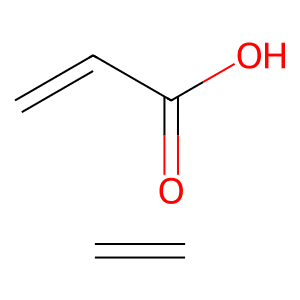
CAS 9010-77-9
:Acrylic acid-ethylene copolymer
Description:
Acrylic acid-ethylene copolymer, identified by the CAS number 9010-77-9, is a type of polymer that combines the properties of acrylic acid and ethylene. This copolymer is characterized by its excellent adhesion, flexibility, and resistance to water and various chemicals, making it suitable for a wide range of applications. It typically exhibits good thermal stability and can be processed through various methods, including extrusion and molding. The copolymer's structure allows for tunable properties, which can be adjusted by varying the ratio of acrylic acid to ethylene in the formulation. This versatility makes it valuable in industries such as coatings, adhesives, and sealants, where it can enhance performance characteristics like durability and elasticity. Additionally, acrylic acid-ethylene copolymer can be modified to improve its compatibility with other materials, further expanding its utility in composite formulations. Overall, its unique combination of properties makes it a significant material in both industrial and consumer applications.
Formula:(C3H4O2·C2H4)x
InChI:InChI=1S/C3H4O2.C2H4/c1-2-3(4)5;1-2/h2H,1H2,(H,4,5);1-2H2
InChI key:InChIKey=QHZOMAXECYYXGP-UHFFFAOYSA-N
SMILES:C(C=C)(O)=O.C=C
Synonyms:- 5980I
- EAA
- Primacor
- Vistafix
- Zaikthene
- Poly(ethylene-co-acrylic acid)
- Ethene, polymer with 2-propenoic acid
- 2-Propenoic acid, polymer with ethene
- prop-2-enoic acid - ethene (1:1)
- Ethylene, polymer with acrylic acid
- Ethylene-acrylic acid resin (90/10
- Ethylene-acrylic acid copolymer
- Ethylene acrylic acid copolymer
- See more synonyms
Sort by
Purity (%)
0
100
|
0
|
50
|
90
|
95
|
100
Found 3 products.
Poly(Ethylene-Co-Acrylic Acid)
CAS:Poly(Ethylene-Co-Acrylic Acid)
Purity:acrylic acid 15 wt. %, MFR: 38 g/10min (190℃/2.16kPoly(ethylene-co-acrylic acid)
CAS:Controlled ProductPoly(ethylene-co-acrylic acid) is a polymer with alternating ethylene and acrylic acid monomers. The cyclic peptide is composed of two amino acids, lysine and aspartic acid, which are covalently linked by the carbonyl group. This polymer has a surface methodology that can be used for light emission in cell culture. It also has chemical interactions with metal hydroxides, such as aluminum hydroxide, and polymeric matrixes, such as polystyrene. Poly(ethylene-co-acrylic acid) absorbs ultraviolet light and emits visible light when excited by an energy source. Poly(ethylene-co-acrylic acid) is chemically stable and does not degrade upon exposure to oxygen or water.Formula:(C2H4)x•(C3H4O2)yPurity:Min. 95%Color and Shape:Powder