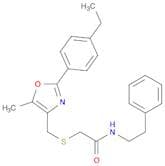
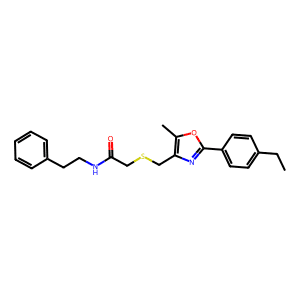
CAS 901751-47-1
:2-[[[2-(4-ethylphenyl)-5-methyl-4-oxazolyl]methyl]thio]-N-(2-phenylethyl)acetamide
Description:
The chemical substance known as 2-[[[2-(4-ethylphenyl)-5-methyl-4-oxazolyl]methyl]thio]-N-(2-phenylethyl)acetamide, with the CAS number 901751-47-1, is a synthetic organic compound characterized by its complex structure, which includes an oxazole ring, a thioether linkage, and an acetamide functional group. This compound features a phenyl group and an ethyl-substituted phenyl moiety, contributing to its hydrophobic characteristics. The presence of the oxazole ring suggests potential biological activity, as heterocycles often play significant roles in medicinal chemistry. The thioether group may enhance the compound's lipophilicity and influence its interaction with biological targets. Additionally, the acetamide moiety can participate in hydrogen bonding, which may affect the compound's solubility and reactivity. Overall, this compound's unique structural features may confer specific pharmacological properties, making it of interest in drug development and research. However, detailed studies would be necessary to fully elucidate its biological activity and potential applications.
Formula:C23H26N2O2S
Synonyms:- iCRT3
- CS-2716
- 2-[[[2-(4-ethylphenyl)-5-methyl-4-oxazolyl]methyl]thio]-N-(2-phenylethyl)acetamide
- ICRT3;ICRT-3;ICRT 3
- Acetamide, 2-[[[2-(4-ethylphenyl)-5-methyl-4-oxazolyl]methyl]thio]-N-(2-phenylethyl)-
Sort by
Purity (%)
0
100
|
0
|
50
|
90
|
95
|
100
Found 5 products.
iCRT3
CAS:iCRT3 is a Wnt and β-catenin-responsive transcription inhibitor.Formula:C23H26N2O2SPurity:98.32% - 98.47%Color and Shape:SolidMolecular weight:394.53iCRT3
CAS:iCRT3 is a natural compound that has been shown to reduce kidney fibrosis and improve the prognosis of patients with chronic kidney disease. It has been shown to inhibit the growth of skin cancer cells in vivo models. iCRT3 has also been found to regulate cellular physiology by inhibiting signal pathways, such as epidermal growth factor (EGF) and pro-apoptotic proteins. In addition, it was found to increase ATP levels in caco2 cells by reducing oxidative stress and inflammation.
Formula:C23H26N2O2SPurity:Min. 95%Molecular weight:394.53 g/mol