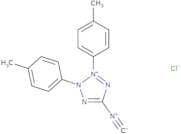
CAS 90217-02-0
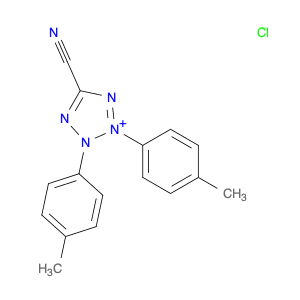
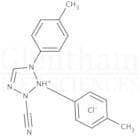
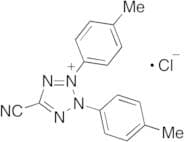
:5-Cyano-2,3-di-p-tolyltetrazolium chloride
Description:
5-Cyano-2,3-di-p-tolyltetrazolium chloride, commonly referred to as CTAC, is a chemical compound characterized by its tetrazolium structure, which is a five-membered ring containing four nitrogen atoms. This compound is typically used as a redox indicator and is known for its ability to undergo reduction, forming a colored formazan product, which is useful in various biochemical assays, particularly in cell viability and proliferation studies. The presence of cyano and p-tolyl groups enhances its solubility and stability in organic solvents. CTAC is often utilized in laboratory settings for its role in colorimetric assays, allowing researchers to quantify cellular metabolic activity. As with many tetrazolium salts, it is important to handle this compound with care, as it may pose health risks if ingested or inhaled. Proper safety protocols should be followed when working with this substance, including the use of personal protective equipment and working in a well-ventilated area.
Formula:C16H14ClN5
InChI:InChI=1/C16H14N5.ClH/c1-12-3-7-14(8-4-12)20-18-16(11-17)19-21(20)15-9-5-13(2)6-10-15;/h3-10H,1-2H3;1H/q+1;/p-1
InChI key:InChIKey=SSJZAXOTLCJNLF-UHFFFAOYSA-M
SMILES:C(#N)C1=NN([N+](=N1)C2=CC=C(C)C=C2)C3=CC=C(C)C=C3.[Cl-]
Synonyms:- 2H-Tetrazolium, 5-cyano-2,3-bis(4-methylphenyl)-, chloride
- 2H-Tetrazolium, 5-cyano-2,3-bis(4-methylphenyl)-, chloride (1:1)
- 5-Cyano-2,3-di-p-tolyltetrazolium chloride
- 5-cyano-2,3-bis(4-methylphenyl)-2H-tetrazol-3-ium chloride
- CTC (biological stain)
- CTC
- 5-CYANO-2,3-DI-(P-TOLYL)TETRAZOLIUM CHLORIDE
- CYANOTOLYL TETRAZOLIUM CHLORIDE (CTC)
- 5-Cyano-2,3-di-(p-tolyl)tetrazolium chloride, ≥85% (HPLC)
- CTC 5-Cyano-2,3-ditolyl tetrazolium chloride
- Cyanotolyl Tetrazolium, Ctc
- 5-CYANO-2,3-DITOLYL TETRAZOLIUM CHLORIDE
- 5-CYANO-2,3-BIS(4-METHYLPHENYL)-2H-TETRAZOLIUM CHLORIDE
- CYANODITOLYL TETRAZOLIUM CHLORIDE
- 5-Cyano-2,3-bis(4-methylphenyl)tetrazolium chloride
- See more synonyms
Sort by
Purity (%)
0
100
|
0
|
50
|
90
|
95
|
100
Found 6 products.
2H-Tetrazolium, 5-cyano-2,3-bis(4-methylphenyl)-, chloride (1:1)
CAS:Formula:C16H16ClN5Purity:98%Color and Shape:SolidMolecular weight:313.78475-Cyano-2,3-ditolyl tetrazolium chloride
CAS:5-Cyano-2,3-ditolyl tetrazolium chlorideColor and Shape:Off-White SolidMolecular weight:311.77g/mol5-Cyano-2,3-di-p-tolyltetrazolium Chloride (>85%)
CAS:Controlled ProductFormula:C16H14N5·ClPurity:>85%Color and Shape:NeatMolecular weight:311.7695-Cyano-2,3-di-(p-tolyl)tetrazolium chloride
CAS:5-Cyano-2,3-di-(p-tolyl)tetrazolium chloride is a tetrazolium dye used as an indicator of eukaryotic cells in a range or media including waste water resulting in a cyan color. It is commonly used in microbiology laboratories to measure the viability of cells. The redox potentials of 5-Cyano-2,3-di-(p-tolyl)tetrazolium chloride are reduced by the presence of active respiratory cells, resulting in fluorescent formazan.
Formula:C16H14ClN5Color and Shape:PowderMolecular weight:311.77 g/mol5-Cyano-2,3-di-(p-tolyl)tetrazolium chloride
CAS:5-Cyano-2,3-di-(p-tolyl)tetrazolium chloride (5CDTT) is a tetrazolium dye that can be used as an indicator of bacterial cell lysis. It binds to the enzyme catalase and inhibits its activity. 5CDTT is also a fluorescent derivative that emits red light when activated by ultraviolet light. 5CDTT has been shown to bind to bacteria and cells in culture, which causes cellular lysis and releases intracellular contents into the surrounding medium. 5CDTT has been shown to inhibit the growth of Gram negative bacteria such as Escherichia coli K-12 and Salmonella typhimurium, but not Gram positive bacteria such as Staphylococcus aureus or Bacillus subtilis.Formula:C16H14ClN5Molecular weight:311.77 g/molRef: 3D-C-8720
1gTo inquire5gTo inquire250mgTo inquire500mgTo inquire2500mgTo inquire-Unit-ggTo inquire