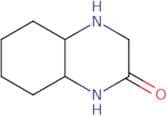
CAS 90242-76-5
:2(1H)-Quinoxalinone,octahydro-(6CI,7CI,9CI)
Description:
2(1H)-Quinoxalinone, octahydro- (CAS 90242-76-5) is a bicyclic compound characterized by its fused ring structure, which includes a quinoxalinone moiety. This substance typically exhibits a range of chemical properties due to the presence of nitrogen atoms in its structure, contributing to its potential basicity and reactivity. The octahydro designation indicates that the compound is fully saturated, which affects its physical properties, such as solubility and boiling point. It may also display biological activity, making it of interest in medicinal chemistry and pharmacology. The compound's structural features suggest potential applications in the development of pharmaceuticals or agrochemicals. Additionally, its stability and reactivity can be influenced by the presence of functional groups and the overall molecular conformation. As with many nitrogen-containing heterocycles, it may participate in various chemical reactions, including nucleophilic substitutions and cycloadditions, depending on the reaction conditions. Overall, 2(1H)-Quinoxalinone, octahydro- is a versatile compound with potential utility in various chemical and biological contexts.
Formula:C8H14N2O
Synonyms:- Octahydroquinoxalin-2(1H)-One
- 2(1H)-Quinoxalinone,octahydro-(6CI,7CI,9CI)
- octahydro-2(1h)-quinoxalinone
- decahydroquinoxalin-2-one
- Octahydro-quinoxalin-2-one
- Octahydro-1H-quinoxalin-2-one
- 2(1H)-Quinoxalinone, octahydro-
Sort by
Purity (%)
0
100
|
0
|
50
|
90
|
95
|
100
Found 1 products.
Decahydroquinoxalin-2-one
CAS:Decahydroquinoxalin-2-one is a mitochondrial membrane potential stabilizer. It binds to the imine moiety of the mitochondrial membrane and prevents collapse of the mitochondrial membrane potential, which is essential for cell survival. Decahydroquinoxalin-2-one also has an antiproliferative effect on cancer cells. The proapoptotic activity of decahydroquinoxalin-2-one has been shown in some studies; however, this activity has not been demonstrated in all cases, suggesting that it may have other mechanisms of action. Decahydroquinoxalin-2-one is currently being studied as a possible treatment for cancer and Parkinson’s disease.Formula:C8H14N2OPurity:Min. 95%Molecular weight:154.21 g/mol