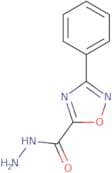
CAS 90323-72-1
:1,2,4-Oxadiazole-5-carboxylic acid, 3-phenyl-, hydrazide
Description:
1,2,4-Oxadiazole-5-carboxylic acid, 3-phenyl-, hydrazide is a chemical compound characterized by its oxadiazole ring structure, which is a five-membered heterocyclic compound containing two nitrogen atoms and three carbon atoms. This compound features a carboxylic acid functional group and a hydrazide moiety, contributing to its potential reactivity and biological activity. The presence of the phenyl group enhances its aromatic characteristics, which can influence its solubility and interaction with other molecules. Typically, compounds of this nature may exhibit various biological activities, including antimicrobial or anti-inflammatory properties, making them of interest in pharmaceutical research. The molecular structure allows for potential hydrogen bonding and interactions with biological targets. Additionally, the compound's stability, solubility, and reactivity can vary based on environmental conditions such as pH and temperature. Overall, 1,2,4-Oxadiazole-5-carboxylic acid, 3-phenyl-, hydrazide represents a class of compounds that may have significant applications in medicinal chemistry and material science.
Formula:C9H8N4O2
InChI:InChI=1S/C9H8N4O2/c10-12-8(14)9-11-7(13-15-9)6-4-2-1-3-5-6/h1-5H,10H2,(H,12,14)
InChI key:InChIKey=CUZXTYBNQLZUTH-UHFFFAOYSA-N
SMILES:C(NN)(=O)C1=NC(=NO1)C2=CC=CC=C2
Synonyms:- 3-Phenyl-1,2,4-oxadiazole-5-carbohydrazide
- 1,2,4-Oxadiazole-5-carboxylic acid, 3-phenyl-, hydrazide
- 3-Phenyl-[1,2,4]oxadiazole-5-carboxylic acid hydrazide
Sort by
Purity (%)
0
100
|
0
|
50
|
90
|
95
|
100
Found 1 products.
3-Phenyl-1,2,4-oxadiazole-5-carbohydrazide
CAS:Phenyl-1,2,4-oxadiazole-5-carbohydrazide (POD) is a heterocycle that has analgesic properties. It is an analgesic agent that belongs to the group of arylidene hydrazides. POD binds to the opioid receptors in the brain, which causes pain relief. POD is structurally related to dipyrone and has similar pharmacological profile. The drug was shown to be effective in reducing constrictions in guinea pigs and rats.
Formula:C9H8N4O2Purity:Min. 95%Molecular weight:204.19 g/mol