CAS 90429-09-7
:(4-formyl-2-methoxy-5-nitrophenoxy)acetic acid
Description:
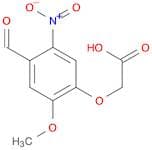
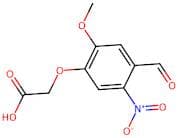
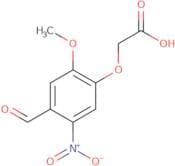
(4-formyl-2-methoxy-5-nitrophenoxy)acetic acid, identified by its CAS number 90429-09-7, is an organic compound characterized by its complex structure, which includes a phenolic moiety substituted with a formyl group, a methoxy group, and a nitro group. This compound typically exhibits a yellow to orange color due to the presence of the nitro group, which can also influence its reactivity and solubility in various solvents. It is likely to be soluble in polar organic solvents, while its acidic carboxylic group may impart some degree of solubility in water. The presence of multiple functional groups suggests that it may participate in various chemical reactions, including nucleophilic substitutions and condensation reactions. Additionally, the compound may exhibit biological activity, making it of interest in pharmaceutical and agrochemical research. Its stability and reactivity can be influenced by environmental factors such as pH and temperature, which are important considerations for its practical applications.
Formula:C10H9NO7
InChI:InChI=1/C10H9NO7/c1-17-8-2-6(4-12)7(11(15)16)3-9(8)18-5-10(13)14/h2-4H,5H2,1H3,(H,13,14)
SMILES:COc1cc(C=O)c(cc1OCC(=O)O)N(=O)=O
Synonyms:- Acetic acid, (4-formyl-2-methoxy-5-nitrophenoxy)-
Sort by
Purity (%)
0
100
|
0
|
50
|
90
|
95
|
100
Found 3 products.
2-(4-Formyl-2-methoxy-5-nitrophenoxy)acetic acid
CAS:Formula:C10H9NO7Color and Shape:SolidMolecular weight:255.18102-(4-Formyl-2-methoxy-5-nitrophenoxy)acetic acid
CAS:2-(4-Formyl-2-methoxy-5-nitrophenoxy)acetic acidPurity:95%Molecular weight:255.18g/mol4-Formyl-6-methoxy-3-nitrophenoxyacetic acid
CAS:4-Formyl-6-methoxy-3-nitrophenoxyacetic acid is a photolabile formylated nitrophenol that is used to study the formation of concentration gradients across cell membranes. 4-Formyl-6-methoxy-3-nitrophenoxyacetic acid has been found to react with proton gradients and formyl groups in the membrane, which produces formaldehyde. The reaction mechanism for this process is not well understood, but it has been proposed that the reaction proceeds through a transducing step in which an electron from the formyl group reacts with a proton gradient to produce a formate ion. This mechanism is supported by experiments that show that the rate of photochemical reactions increases as the pH gradient across the membrane decreases.
Formula:C10H9NO7Purity:Min. 95%Molecular weight:255.18 g/mol