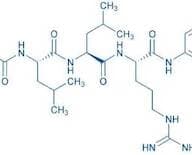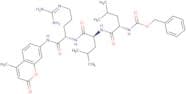
CAS 90468-17-0
:Z-Leu-Leu-Arg-AMC
Description:
Z-Leu-Leu-Arg-AMC, also known by its CAS number 90468-17-0, is a synthetic peptide substrate commonly used in biochemical research, particularly in studies involving proteases. This compound features a Z (benzyloxycarbonyl) protecting group on the N-terminus, which enhances its stability and solubility. The sequence includes leucine (Leu) and arginine (Arg) residues, which are crucial for its interaction with specific enzymes. The AMC (7-amino-4-methylcoumarin) moiety serves as a fluorescent reporter, allowing for the detection of enzymatic activity through fluorescence measurements. This substrate is particularly valuable in assays for studying proteolytic enzymes, as the cleavage of the peptide bond releases the AMC, resulting in an increase in fluorescence that can be quantitatively measured. Z-Leu-Leu-Arg-AMC is typically used in laboratory settings to investigate enzyme kinetics, substrate specificity, and the effects of inhibitors on protease activity. Its characteristics make it a useful tool in both basic and applied research in biochemistry and molecular biology.
Formula:C36H4N7O7
Sort by
Purity (%)
0
100
|
0
|
50
|
90
|
95
|
100
Found 2 products.
Z-Leu-Leu-Arg-AMC
CAS:Fluorogenic substrate for cathepsin S. Z-LLR-AMC is also cleaved by falcipain and related enzymes from plasmodium species.Formula:C36H49N7O7Purity:>99%Color and Shape:White PowderMolecular weight:691.83Z-Leu-Leu-Arg-AMC
CAS:Z-Leu-Leu-Arg-AMC is a proteolytic substrate that is used to study the activation of Th17 cells. It activates these cells by binding to the antigen peptide and protease activity, which are involved in the immune response. Z-Leu-Leu-Arg-AMC has been shown to induce autoimmune diseases in mice, as well as other conditions such as chronic inflammation and obesity. This compound also has a potential drug target for neutralizing acidity, which could be useful in treating cancer and other diseases. Z-Leu-Leu-Arg-AMC is stable at acidic pHs and can be used for biochemical studies of proteases at acidic pHs.Formula:C36H49N7O7Purity:Min. 95%Color and Shape:PowderMolecular weight:691.82 g/mol