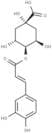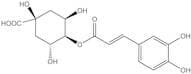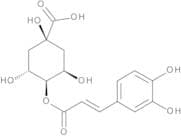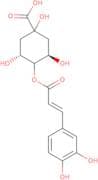
CAS 905-99-7
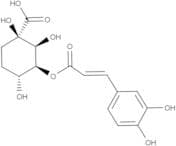
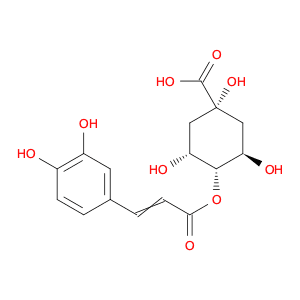
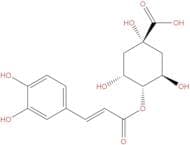
:4-Caffeoylquinic acid
- (1α,3R,4α,5R)-4-[[3-(3,4-Dihydroxyphenyl)-1-oxo-2-propen-1-yl]oxy]-1,3,5-trihydroxycyclohexanecarboxylic acid
- 3,4-Dihydroxycinnamic acid 4-carboxy-2,4,6-trihydroxycyclohexyl ester
- 4-Caffeoylquinic acid
- 4-O-Caffeoylquinic acid
- Cinnamic acid, 3,4-dihydroxy-, 4-carboxy-2,4,6-trihydroxycyclohexyl ester
- Cyclohexanecarboxylic acid, 4-[[3-(3,4-dihydroxyphenyl)-1-oxo-2-propen-1-yl]oxy]-1,3,5-trihydroxy-, (1α,3R,4α,5R)-
- Cyclohexanecarboxylic acid, 4-[[3-(3,4-dihydroxyphenyl)-1-oxo-2-propenyl]oxy]-1,3,5-trihydroxy-, (1α,3R,4α,5R)-
- Cyclohexanecarboxylic acid, 4-[[3-(3,4-dihydroxyphenyl)-1-oxo-2-propenyl]oxy]-1,3,5-trihydroxy-, [1R-(1α,3α,4α,5β)]-
- Quinic acid 4-O-caffeate
Cryptochlorogenic acid
CAS:Cryptochlorogenic acid analytical standard provided with w/w absolute assay, to be used for quantitative titration.Formula:C16H18O9Purity:(HPLC) ≥98%Color and Shape:PowderMolecular weight:354.31Cryptochlorogenic acid
CAS:Chlorogenic acid has antioxidative activity, superoxide anion radicals, and radical scavenging activity.Formula:C16H18O9Purity:95%~99%Color and Shape:White powderMolecular weight:354.3114-O-Caffeoylquinic acid
CAS:Formula:C16H18O9Purity:≥ 98.0%Color and Shape:White to off-white powderMolecular weight:354.31Cryptochlorogenic acid
CAS:1. Cryptochlorogenic acid (4-O-Caffeoylquinic acid) has antioxidant activity.Formula:C16H18O9Purity:99.56% - 99.66%Color and Shape:SolidMolecular weight:354.31Ref: TM-T6S1537
2mg38.00€5mg55.00€1mL*10mM (DMSO)59.00€10mg93.00€25mg138.00€50mg197.00€100mg293.00€200mg434.00€Cryptochlorogenic acid
CAS:Carboxylic acid with additional oxygen functionsFormula:C16H18O9Purity:≥ 98.0 % (HPLC)Color and Shape:PowderMolecular weight:354.314-O-Caffeoylquinic Acid
CAS:Controlled ProductStability Hygroscopic
Applications 4-O-Caffeoylquinic Acid is used as an antibiotic, and antioxidant agent.
References Xu, H. et al.: Food Sci. Biotech., 23, 2013 (2014);Formula:C16H18O9Color and Shape:NeatMolecular weight:354.31Cryptochlorogenic acid
CAS:Cryptochlorogenic acid is an isomer of chlorogenic acid and is found in plants. Cryptochlorogenic acid is the major component of the extract of mulberry leaves that is traditionally used to treat diabetes mellitus. In a diabetic model in rats, cryptochlorogenic acid alleviated symptoms, such as, blood glucose levels, accumulation of lipid peroxides, and iron content alterations. In vitro studies with RAW 264.7 macrophages, cryptochlorogenic acid showed antioxidant and anti-inflammatory activity by increasing both the cellular content of reduced glutathione, and the expression of superoxide dismutase activity, while inhibiting the nuclear translocation of the nuclear factor erythroid 2ârelated factor 2 (Nrf2).
Formula:C16H18O9Purity:Min. 98 Area-%Color and Shape:PowderMolecular weight:354.31 g/mol