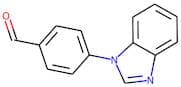
CAS 90514-72-0
:Benzaldehyde,4-(1H-benzimidazol-1-yl)-
Description:
Benzaldehyde, 4-(1H-benzimidazol-1-yl)-, is an organic compound characterized by the presence of a benzaldehyde functional group attached to a benzimidazole moiety. This compound typically exhibits a pale yellow to colorless liquid appearance and has a distinct aromatic odor, characteristic of benzaldehyde derivatives. It is soluble in organic solvents such as ethanol and ether but has limited solubility in water due to its hydrophobic nature. The presence of the benzimidazole ring contributes to its potential biological activity, making it of interest in medicinal chemistry and pharmaceutical research. The compound may participate in various chemical reactions, including electrophilic aromatic substitution and nucleophilic addition, owing to the reactivity of both the aldehyde and the nitrogen atoms in the benzimidazole structure. Safety data indicates that, like many aromatic compounds, it should be handled with care due to potential irritant properties. Overall, Benzaldehyde, 4-(1H-benzimidazol-1-yl)- is a compound of interest for its chemical properties and potential applications in various fields.
Formula:C14H10N2O
Synonyms:- 1-(4-Formylphenyl)-1H-benzimidazole
- 4-(1H-Benzimidazol-1-yl)benzaldehyde
- 4-(Benzimidazol-1-yl)benzaldehyde
Sort by
Purity (%)
0
100
|
0
|
50
|
90
|
95
|
100
Found 2 products.
4-(1H-1,3-Benzodiazol-1-yl)benzaldehyde
CAS:4-(1H-1,3-Benzodiazol-1-yl)benzaldehydePurity:95%Molecular weight:222.24g/mol4-(1H-1,3-Benzimidazol-1-yl)benzenecarbaldehyde
CAS:4-(1H-1,3-Benzimidazol-1-yl)benzenecarbaldehyde (BABA) is an imidazole that can be used for labeling and detection. It has been shown to react with hydrosulfite in the presence of chloroform to produce a fluorescent compound. This compound can be detected using UV light at 365 nm. BABA has also been shown to react with chalcone in the presence of potassium cyanide in order to produce a fluorescent compound. BABA is also used as a reagent in the detection of Leishmania organisms and has been shown to have low detection limits. This compound is often used as a leukocyte lysis agent and can be activated by guanidine hydrochloride.
Formula:C14H10N2OPurity:Min. 95%Molecular weight:222.24 g/molRef: 3D-QDA51472
Discontinued product