CAS 90562-36-0
:8-Chloro-1,2,3,4-tetrahydroquinoline
Description:
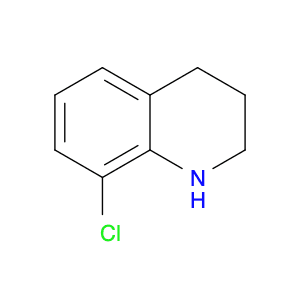
8-Chloro-1,2,3,4-tetrahydroquinoline is a heterocyclic organic compound characterized by its bicyclic structure, which includes a quinoline framework with a chlorine substituent at the 8-position. This compound typically exhibits a pale yellow to light brown appearance and is soluble in organic solvents. Its molecular structure consists of a fused benzene and pyridine ring, contributing to its potential biological activity. The presence of the chlorine atom can influence its reactivity and interactions with biological targets, making it of interest in medicinal chemistry. 8-Chloro-1,2,3,4-tetrahydroquinoline may exhibit various pharmacological properties, including antimicrobial and anticancer activities, although specific biological effects can vary based on the context of use. As with many organic compounds, safety and handling precautions are essential, as it may pose health risks if ingested or inhaled. Overall, this compound represents a significant area of study for researchers exploring novel therapeutic agents.
Formula:C9H10ClN
InChI:InChI=1S/C9H10ClN/c10-8-5-1-3-7-4-2-6-11-9(7)8/h1,3,5,11H,2,4,6H2
InChI key:InChIKey=NLSDMOYGCYVCFC-UHFFFAOYSA-N
SMILES:ClC1=C2C(=CC=C1)CCCN2
Synonyms:- 8-Chloro-1,2,3,4-Tetrahydroquinoline
- Quinoline, 8-chloro-1,2,3,4-tetrahydro-
Sort by
Purity (%)
0
100
|
0
|
50
|
90
|
95
|
100
Found 4 products.
Quinoline, 8-chloro-1,2,3,4-tetrahydro-
CAS:Formula:C9H10ClNPurity:98%Color and Shape:LiquidMolecular weight:167.63548-Chloro-1,2,3,4-tetrahydroquinoline
CAS:8-Chloro-1,2,3,4-tetrahydroquinolinePurity:98%Molecular weight:167.64g/mol8-Chloro-1,2,3,4-tetrahydroquinoline
CAS:Controlled Product8-Chloro-1,2,3,4-tetrahydroquinoline is a quinoline that is selectively used as an intermediate in the synthesis of other compounds. 8-Chloro-1,2,3,4-tetrahydroquinoline can be dehydrogenated to 8-chloroindole or transaminated to form an indole. It can also be converted into azaheterocycles by reaction with various types of heterocyclic amines. This chemical has been shown to undergo cyclization reactions to form bicyclic and cyclohexanones, which are useful in the synthesis of pharmaceuticals and agrochemicals.
Formula:C9H10ClNPurity:Min. 95%Molecular weight:167.64 g/mol