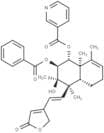
CAS 905929-95-5
:(1R,2S,3R,4R,4aS,8aR)-3-hydroxy-3,4,8,8a-tetramethyl-4-[(E)-2-(5-oxo-2,5-dihydrofuran-3-yl)ethenyl]-2-[(phenylcarbonyl)oxy]-1,2,3,4,4a,5,6,8a-octahydronaphthalen-1-yl pyridine-3-carboxylate
Description:
The chemical substance with the name "(1R,2S,3R,4R,4aS,8aR)-3-hydroxy-3,4,8,8a-tetramethyl-4-[(E)-2-(5-oxo-2,5-dihydrofuran-3-yl)ethenyl]-2-[(phenylcarbonyl)oxy]-1,2,3,4,4a,5,6,8a-octahydronaphthalen-1-yl pyridine-3-carboxylate" and CAS number "905929-95-5" is a complex organic compound characterized by its intricate stereochemistry and multiple functional groups. This compound features a naphthalene core structure that is heavily substituted, including hydroxyl, carbonyl, and ester functionalities, which contribute to its potential biological activity. The presence of a pyridine ring suggests possible interactions with biological targets, making it of interest in medicinal chemistry. Its stereochemical configuration indicates specific spatial arrangements of atoms, which can significantly influence its reactivity and interactions. The compound's molecular structure suggests it may exhibit unique properties, such as solubility and stability, depending on the surrounding environment. Overall, this substance represents a sophisticated example of organic synthesis with potential applications in pharmaceuticals or agrochemicals.
Formula:C33H35NO7
InChI:InChI=1/C33H35NO7/c1-21-10-8-14-25-31(2,16-15-22-18-26(35)39-20-22)33(4,38)28(41-29(36)23-11-6-5-7-12-23)27(32(21,25)3)40-30(37)24-13-9-17-34-19-24/h5-7,9-13,15-19,25,27-28,38H,8,14,20H2,1-4H3/b16-15+/t25-,27+,28+,31-,32+,33+/m1/s1
Sort by
Purity (%)
0
100
|
0
|
50
|
90
|
95
|
100
Found 4 products.
Scutebarbatine B
CAS:Scutebarbatine B shows weak cytotoxicity with IC50 values ranging from 35.11 to 42.73 μM against K562 cell lines and HL60 cell lines.Formula:C33H35NO7Purity:98%Color and Shape:SolidMolecular weight:557.63Scutebarbatine B
CAS:Scutebarbatine B is a bioactive alkaloid, which is derived from the roots of the Scutellaria genus, particularly known in species like Scutellaria barbata. This compound belongs to a class of naturally occurring phytochemicals prevalent in these plants, which have been used in traditional medicine. The mode of action of Scutebarbatine B involves interaction with specific neurotransmitter pathways, possessing potential neuroactive properties that may modulate neuronal excitability and neurochemical balance.Formula:C33H35NO7Purity:Min. 95%Molecular weight:557.6 g/mol