CAS 909561-15-5
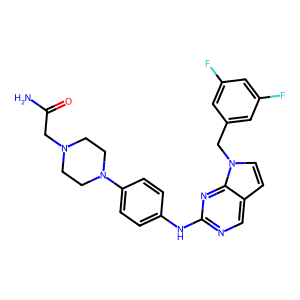
:1-Piperazineacetamide, 4-[4-[[7-[(3,5-difluorophenyl)methyl]-7H-pyrrolo[2,3-d]pyrimidin-2-yl]amino]phenyl]-
Description:
1-Piperazineacetamide, 4-[4-[[7-[(3,5-difluorophenyl)methyl]-7H-pyrrolo[2,3-d]pyrimidin-2-yl]amino]phenyl]- is a chemical compound characterized by its complex structure, which includes a piperazine ring and a pyrrolopyrimidine moiety. This compound is typically classified as a small molecule and may exhibit properties relevant to medicinal chemistry, particularly in the context of drug development. The presence of fluorine atoms in the difluorophenyl group can influence its pharmacokinetic properties, such as lipophilicity and metabolic stability. The piperazine and acetamide functionalities may contribute to its biological activity, potentially interacting with various biological targets. The compound's CAS number, 909561-15-5, allows for precise identification in chemical databases. Overall, this substance may be of interest in research related to therapeutic applications, particularly in areas such as oncology or neurology, where pyrimidine derivatives are often explored for their potential efficacy.
Formula:C25H25F2N7O
Synonyms:- 1-Piperazineacetamide, 4-[4-[[7-[(3,5-difluorophenyl)methyl]-7H-pyrrolo[2,3-d]pyrimidin-2-yl]amino]phenyl]-
- AS1810722
Sort by
Purity (%)
0
100
|
0
|
50
|
90
|
95
|
100
Found 3 products.
AS1810722
CAS:AS1810722, a fused bicyclic pyrimidine derivative, is an orally active and potent inhibitor of STAT6, demonstrating an IC50 of 1.9 nM.Formula:C25H25F2N7OPurity:99.13%Color and Shape:SolidMolecular weight:477.51aS1810722
CAS:aS1810722 is a potent inhibitor of kinases that has shown promise in the treatment of cancer. This protein analog is derived from human urine and has been found to inhibit the activity of ghrelin, which is known to promote tumor growth. In preclinical studies, aS1810722 has demonstrated strong anticancer activity by inducing apoptosis in cancer cells and inhibiting tumor growth. This inhibitor has been tested on Chinese hamster ovary cells and has shown promising results as a potential therapeutic agent for the treatment of various cancers. Its specificity for kinases makes it an attractive candidate for targeted cancer therapy.Formula:C25H25F2N7OPurity:Min. 95%Molecular weight:477.5 g/mol