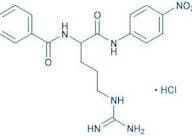
CAS 911-77-3
:N-α-Benzoyl-DL-arginine-p-nitroanilide hydrochloride
- Benzamide, N-[4-[(aminoiminomethyl)amino]-1-[[(4-nitrophenyl)amino]carbonyl]butyl]-, hydrochloride (1:1)
- Benzamide, N-[4-[(aminoiminomethyl)amino]-1-[[(4-nitrophenyl)amino]carbonyl]butyl]-, monohydrochloride
- N-Benzoyl-Dl-Arginine-4-Nitroanilide Hydrochloride
- N-α-Benzoyl-<span class="text-smallcaps">D</smallcap><smallcap>L</span>-arginine-p-nitroanilide hydrochloride
- N<sup>α</sup>-Benzoyl-<span class="text-smallcaps">D</smallcap><smallcap>L</span>-arginine-p-nitroanilide hydrochloride
- NSC 83264
- Valeranilide, 2-benzamido-5-guanidino-4′-nitro-, monohydrochloride, <span class="text-smallcaps">DL</span>-
- Nα-Benzoyl-DL-arginine-p-nitroanilide hydrochloride
- Valeranilide, 2-benzamido-5-guanidino-4′-nitro-, monohydrochloride, DL-
Benzamide, N-[4-[(aminoiminomethyl)amino]-1-[[(4-nitrophenyl)amino]carbonyl]butyl]-, hydrochloride (1:1)
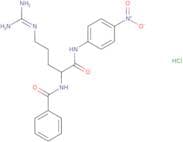
CAS:Formula:C19H23ClN6O4Purity:97%Color and Shape:SolidMolecular weight:434.8767N-Benzoyl-DL-arginine-4-nitroanilide hydrochloride
CAS:N-Benzoyl-DL-arginine-4-nitroanilide hydrochlorideFormula:C19H22N6O4·ClHColor and Shape:Pale Yellow PowderMolecular weight:434.88g/molN-Benzoyl-DL-arginine 4-nitroanilide hydrochloride
CAS:N-α-benzoyl-DL-arginine-4-nitroanilide hydrochloride is commonly used as a substrate in various enzymatic assays, particularly for studying proteases like trypsin and chymotrypsin. It serves as a synthetic substrate to measure the activity of these enzymes. For instance, it has been used to determine trypsin activity in different organisms and tissues. The substrate has also been employed in studying the enzymatic properties of various proteases, including those found in latex, snake venoms, and plant seeds. Additionally, it has been utilized to assess the effects of different compounds on trypsin activity, such as condensed tannins and wine.
Formula:C19H22N6O4•HClPurity:Min. 95%Color and Shape:PowderMolecular weight:434.88 g/molN-a-Benzoyl-DL-Arginine-4-Nitroanilide Hydrochloride (BANI, L-BAPNA) extrapure, 98%
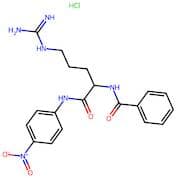
CAS:Formula:C19H22N6O4·HClPurity:min. 98%Color and Shape:Yellow, PowderMolecular weight:434.89N-(5-Guanidino-1-((4-nitrophenyl)amino)-1-oxopentan-2-yl)benzamide hydrochloride
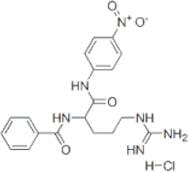
CAS:Formula:C19H23ClN6O4Purity:97%Molecular weight:434.88Bz-DL-Arg-pNA • HCl [DL-BAPA]
CAS:Bz-DL-Arg-pNA • HCl [DL-BAPA] is a trypsin and trypsin-like protease substrate. It is used as a tool in biochemical studies to investigate the degradation of proteins by these enzymes. Bz-DL-Arg-pNA • HCl [DL-BAPA] is also used as an experimental model for diseases that affect enzyme activity, such as rheumatoid arthritis and multiple sclerosis.
Formula:C19H22N6O4•HClPurity:Min. 95%Molecular weight:434.88 g/molBz-DL-Arg-pNA · HCl
CAS:Substrate for trypsin, papain, acrosin, plasmin, cathepsin B, and cathepsin H.Formula:C19H22N6O4·HClPurity:≥ 99%Color and Shape:Light YellowMolecular weight:434.88
![Benzamide, N-[4-[(aminoiminomethyl)amino]-1-[[(4-nitrophenyl)amino]carbonyl]butyl]-, h…](/_next/image/?url=https%3A%2Fstatic.cymitquimica.com%2Fproducts%2FIN%2Fthumb%2FDA00IGHF.jpg&w=3840&q=75)





![Bz-DL-Arg-pNA • HCl [DL-BAPA]](/_next/image/?url=https%3A%2Fstatic.cymitquimica.com%2Fproducts%2F3D%2Fthumb%2FSRN-3013.jpg&w=3840&q=75)