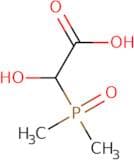
CAS 91154-17-5
:(dimethylphosphoryl)(hydroxy)acetic acid
Description:
(Dimethylphosphoryl)(hydroxy)acetic acid, with the CAS number 91154-17-5, is a chemical compound characterized by the presence of a dimethylphosphoryl group and a hydroxyacetic acid moiety. This compound typically exhibits properties associated with both phosphorous and carboxylic acid functionalities, which may include moderate solubility in polar solvents due to the presence of the hydroxyl group and the carboxylic acid functional group. The dimethylphosphoryl group contributes to its potential reactivity, particularly in biological systems, where it may interact with enzymes or other biomolecules. The compound may also exhibit acidic behavior due to the carboxylic acid group, allowing it to donate protons in solution. Its structure suggests potential applications in fields such as agrochemicals, pharmaceuticals, or as a biochemical probe, although specific applications would depend on further research into its biological activity and stability. Overall, this compound represents a unique combination of phosphorous chemistry and organic acid characteristics.
Formula:C4H9O4P
InChI:InChI=1/C4H9O4P/c1-9(2,8)4(7)3(5)6/h4,7H,1-2H3,(H,5,6)
SMILES:CP(=O)(C)C(C(=O)O)O
Synonyms:- Acetic acid, (dimethylphosphinyl)hydroxy-
Sort by
Purity (%)
0
100
|
0
|
50
|
90
|
95
|
100
Found 1 products.
2-(Dimethylphosphoryl)-2-hydroxyacetic acid
CAS:2-(Dimethylphosphoryl)-2-hydroxyacetic acid (DMPPA) is a herbicide that inhibits acetaldehyde dehydrogenase, an enzyme in the biochemical pathway of acetaldehyde biosynthesis. DMPPA does not have any effect on glutamate and l-threonine metabolism or on the formation of diketones. The target enzyme is activated by the addition of glyphosate to the leaves. DMPPA is used for diagnosis of velvetleaf (Abutilon theophrasti), which is a weed found in corn fields in North America. The chemical can be applied as a foliar spray or as a soil application, with many different formulations available. The chemical has been shown to be effective against graminaceous weeds such as barnyardgrass (Echinochloa crusgalli) and crabgrass (Digitaria spp.).Formula:C4H9O4PPurity:Min. 95%Molecular weight:152.09 g/mol