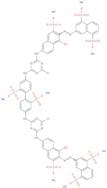
![1,5-Naphthalenedisulfonic acid, 3,3′-[(2,2′-disulfo[1,1′-biphenyl]-4,4′-diyl)bis[imino(6-chloro-1,…](/_next/image/?url=https%3A%2Fstatic.cymitquimica.com%2Fcas-image%2Fthumb-webp%2F311300-15-naphthalenedisulfonic-acid-33-22-disulfo-11-biphenyl-44-diyl-bis-imino-6-chloro-135-triazine-42-diyl-imino-1-hydroxy-3-sulfo-62-naphthalenediyl-21-diazenediyl-bis-sodium-salt-1-8.webp&w=3840&q=75)
CAS 91261-29-9
:1,5-Naphthalenedisulfonic acid, 3,3′-[(2,2′-disulfo[1,1′-biphenyl]-4,4′-diyl)bis[imino(6-chloro-1,3,5-triazine-4,2-diyl)imino(1-hydroxy-3-sulfo-6,2-naphthalenediyl)-2,1-diazenediyl]]bis-, sodium salt (1:8)
Description:
1,5-Naphthalenedisulfonic acid, 3,3′-[(2,2′-disulfo[1,1′-biphenyl]-4,4′-diyl)bis[imino(6-chloro-1,3,5-triazine-4,2-diyl)imino(1-hydroxy-3-sulfo-6,2-naphthalenediyl)-2,1-diazenediyl]]bis-, sodium salt (1:8), with CAS number 91261-29-9, is a complex organic compound characterized by its sulfonic acid groups, which impart high water solubility and enhance its reactivity. This compound features a naphthalene backbone, which is known for its aromatic properties, and is further substituted with multiple sulfonic acid groups, making it an effective dye or pigment in various applications. The presence of imino and triazine functionalities suggests potential uses in dye chemistry, particularly in the synthesis of azo dyes. Its sodium salt form indicates that it is likely used in aqueous solutions, where it can dissociate to release sodium ions. The compound's structural complexity and functional groups contribute to its potential applications in textiles, paper, and other industries requiring colorants or chemical intermediates. Safety and handling precautions should be observed due to its chemical nature and potential reactivity.
Formula:C58H38Cl2N14O26S8·8Na
InChI:InChI=1S/C58H38Cl2N14O26S8.8Na/c59-53-65-55(61-27-7-11-33-25(15-27)17-47(107(95,96)97)49(51(33)75)73-71-31-19-39-35(45(23-31)105(89,90)91)3-1-5-41(39)101(77,78)79)69-57(67-53)63-29-9-13-37(43(21-29)103(83,84)85)38-14-10-30(22-44(38)104(86,87)88)64-58-68-54(60)66-56(70-58)62-28-8-12-34-26(16-28)18-48(108(98,99)100)50(52(34)76)74-72-32-20-40-36(46(24-32)106(92,93)94)4-2-6-42(40)102(80,81)82;;;;;;;;/h1-24,75-76H,(H,77,78,79)(H,80,81,82)(H,83,84,85)(H,86,87,88)(H,89,90,91)(H,92,93,94)(H,95,96,97)(H,98,99,100)(H2,61,63,65,67,69)(H2,62,64,66,68,70);;;;;;;;
InChI key:InChIKey=PXJKIUWFMSBIGJ-UHFFFAOYSA-N
SMILES:S(=O)(=O)(O)C=1C2=C(C(S(=O)(=O)O)=CC(N=NC=3C(S(=O)(=O)O)=CC4=C(C3O)C=CC(NC=5N=C(NC6=CC(S(=O)(=O)O)=C(C=C6)C7=C(S(=O)(=O)O)C=C(NC=8N=C(NC9=CC%10=C(C=C9)C(O)=C(N=NC%11=CC%12=C(C(S(=O)(=O)O)=C%11)C=CC=C%12S(=O)(=O)O)C(S(=O)(=O)O)=C%10)N=C(Cl)N8)C=C7)N=C(Cl)N5)=C4)=C2)C=CC1.[Na]
Synonyms:- Procion Orange H-ER
- Reactive Orange 84
- 1,5-Naphthalenedisulfonic acid, 3,3′-[(2,2′-disulfo[1,1′-biphenyl]-4,4′-diyl)bis[imino(6-chloro-1,3,5-triazine-4,2-diyl)imino(1-hydroxy-3-sulfo-6,2-naphthalenediyl)-2,1-diazenediyl]]bis-, sodium salt (1:8)
- 1,5-Naphthalenedisulfonic acid, 3,3′-[(2,2′-disulfo[1,1′-biphenyl]-4,4′-diyl)bis[imino(6-chloro-1,3,5-triazine-4,2-diyl)imino(1-hydroxy-3-sulfo-6,2-naphthalenediyl)azo]]bis-, octasodium salt
- C.I. Reactive Orange 84
Sort by
Purity (%)
0
100
|
0
|
50
|
90
|
95
|
100
Found 1 products.
C.I.Reactive Orange 84
CAS:C.I.Reactive Orange 84 is an amide, which is a molecule containing both an amine and a carboxylic acid functional group. This compound has been used in microscopy as a reactive dye to study surface methodology and the optimum concentration of potassium phosphate, which activated the dye. The compound has also been used to determine the activity test of wastewater, or the removal of metal hydroxides by means of photocatalytic activity. C.I.Reactive Orange 84 has shown efficient kinetic properties with respect to other dyes in that it can be used for kinetic studies at neutral pH and at low concentrations. C.I.Reactive Orange 84 has also been identified as being reactive with intermolecular hydrogen bonding, which gives it the ability to bind to metal ions such as zinc and copper; this property may have implications in the development of new methods for removing metals from wastewater streams using photocatalysis.br>br>Purity:Min. 95%