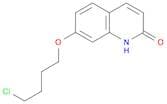
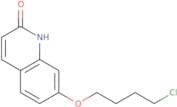
CAS 913613-82-8
:7-(4-Chlorobutoxy)-1H-quinolin-2-one
Description:
7-(4-Chlorobutoxy)-1H-quinolin-2-one, with the CAS number 913613-82-8, is a chemical compound that belongs to the quinoline family, characterized by a quinoline core structure substituted with a butoxy group and a chlorine atom. This compound typically exhibits properties such as moderate solubility in organic solvents and limited solubility in water, which is common for many quinoline derivatives. The presence of the chlorine atom can influence its reactivity and biological activity, potentially enhancing its pharmacological properties. Quinolin-2-ones are often studied for their potential applications in medicinal chemistry, particularly for their antimicrobial, anti-inflammatory, and anticancer activities. The specific characteristics, such as melting point, boiling point, and spectral data, would depend on the compound's purity and the conditions under which it is analyzed. As with many synthetic organic compounds, safety data sheets should be consulted for handling and toxicity information.
- 7-(4-chlorobutoxy)-2(1H)-quinolinone
Sort by
Purity (%)
0
100
|
0
|
50
|
90
|
95
|
100
Found 8 products.
Brexpiprazole Related Compound A (7-(4-Chlorobutoxy)quinolin-2(1H)-one)
CAS:Lactams, nesoiFormula:C13H14ClNO2Color and Shape:White Off-White PowderMolecular weight:251.071312(1H)-Quinolinone,7-(4-chlorobutoxy)-
CAS:Formula:C13H14ClNO2Purity:96%Color and Shape:SolidMolecular weight:251.70887-(4-Chlorobutoxy)quinolin-2(1H)-one
CAS:Controlled ProductFormula:C13H14ClNO2Color and Shape:Light Yellow To BeigeMolecular weight:251.717-(4-chlorobutoxy)quinolin-2(1h)-one
CAS:7-(4-Chlorobutoxy)quinolin-2(1H)-one is a piperazine that is used in the manufacture of many industrial products, including plastics and pesticides. This compound also has been shown to be a modulator of neurotransmission with both depressive and excitatory effects. 7-(4-Chlorobutoxy)quinolin-2(1H)-one has an inhibitory effect on the release of dopamine in the brain, which may be due to its ability to react with dopamine at the synapse. 7-(4-Chlorobutoxy)quinolin-2(1H)-one also inhibits dopamine from binding to its receptor, resulting in decreased stimulation of postsynaptic neurons.Formula:C13H14ClNO2Purity:Min. 95%Molecular weight:251.71 g/mol