


CAS 91574-45-7
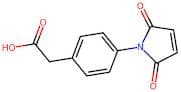
:Benzeneacetic acid, 4-(2,5-dihydro-2,5-dioxo-1H-pyrrol-1-yl)-
Description:
Benzeneacetic acid, 4-(2,5-dihydro-2,5-dioxo-1H-pyrrol-1-yl)-, with the CAS number 91574-45-7, is a chemical compound characterized by its unique structure that combines a benzeneacetic acid moiety with a pyrrole derivative. This compound typically exhibits properties associated with both aromatic and heterocyclic compounds, which may influence its reactivity and solubility. It is likely to be a solid at room temperature, with potential applications in pharmaceuticals or as an intermediate in organic synthesis due to its functional groups. The presence of the pyrrole ring suggests potential biological activity, as many pyrrole derivatives are known for their roles in medicinal chemistry. Additionally, the dioxo functionality may contribute to its reactivity, making it a candidate for further chemical transformations. As with many organic compounds, safety data should be consulted for handling and usage, as well as any regulatory considerations associated with its use in research or industrial applications.
Formula:C12H9NO4
Synonyms:- [2-(4-maleimidophenyl)]acetic acid
Sort by
Purity (%)
0
100
|
0
|
50
|
90
|
95
|
100
Found 4 products.
2-[4-(2,5-dioxo-2,5-dihydro-1h-pyrrol-1-yl)phenyl]acetic acid
CAS:Formula:C12H9NO4Purity:98%Color and Shape:SolidMolecular weight:231.20422-(4-(2,5-Dioxo-2,5-dihydro-1H-pyrrol-1-yl)phenyl)acetic acid
CAS:2-(4-(2,5-Dioxo-2,5-dihydro-1H-pyrrol-1-yl)phenyl)acetic acidPurity:98%Molecular weight:231.20g/mol2-(4-(2,5-Dioxo-2,5-dihydro-1H-pyrrol-1-yl)phenyl)acetic acid
CAS:Purity:98%Molecular weight:231.20700072-[4-(2,5-Dioxo-2,5-dihydro-1H-pyrrol-1-yl)phenyl]acetic acid
CAS:4-Hydroxy-2-[4-(2,5-dioxo-2,5-dihydro-1H-pyrrol-1-yl)phenyl]acetic acid (4HDPA) is a small molecule that is being studied for its anticancer properties. 4HDPA is a prodrug that is converted to 2-[4-(2,5-dioxo-2,5-dihydro-1H-pyrrol-1-yl)phenyl]acetic acid (4DPA), which has been shown to inhibit the growth of lung carcinoma cells in vitro and in vivo. 4DPA inhibits the proliferation of cancer cells by inhibiting the production of proteins vital for cell division. It also blocks the uptake of glucose and amino acids by cancer cells. 4HDPA has been shown to cause apoptosis in cancer cells by activating caspase 3 and 8, which are enzymes involved in cellular death.Formula:C12H9NO4Purity:Min. 95%Molecular weight:231.2 g/mol
![2-[4-(2,5-dioxo-2,5-dihydro-1h-pyrrol-1-yl)phenyl]acetic acid](/_next/image/?url=https%3A%2Fstatic.cymitquimica.com%2Fproducts%2FIN%2Fthumb%2FDA019YG3.jpg&w=3840&q=75)



![2-[4-(2,5-Dioxo-2,5-dihydro-1H-pyrrol-1-yl)phenyl]acetic acid](/_next/image/?url=https%3A%2Fstatic.cymitquimica.com%2Fproducts%2F3D%2Fthumb%2FRDA57445.jpg&w=3840&q=75)
