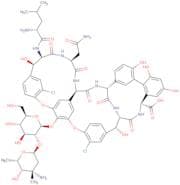
CAS 91700-98-0
:Norvancomycin
Description:
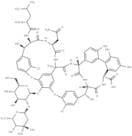
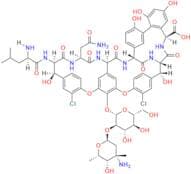
Norvancomycin is a glycopeptide antibiotic derived from vancomycin, primarily used in the treatment of infections caused by Gram-positive bacteria, particularly those resistant to other antibiotics. It exhibits a similar mechanism of action to vancomycin, inhibiting bacterial cell wall synthesis by binding to the D-alanyl-D-alanine terminus of cell wall precursors. This action disrupts the integrity of the bacterial cell wall, leading to cell lysis and death. Norvancomycin is particularly effective against strains of Staphylococcus aureus, including methicillin-resistant Staphylococcus aureus (MRSA). The compound is characterized by its complex structure, which includes multiple aromatic rings and sugar moieties, contributing to its solubility and stability. Its pharmacokinetics, including absorption, distribution, metabolism, and excretion, are similar to those of vancomycin, although specific parameters may vary. Norvancomycin is typically administered intravenously, especially in severe infections, and its use is monitored closely to prevent toxicity and resistance development. Overall, Norvancomycin represents an important therapeutic option in the fight against resistant bacterial infections.
Formula:C65H73Cl2N9O24
InChI:InChI=1/C65H73Cl2N9O24/c1-5-22(2)44(69)58(88)75-48-50(82)25-7-10-36(31(66)13-25)96-38-15-27-16-39(54(38)100-64-55(53(85)52(84)40(21-77)98-64)99-42-20-65(4,70)56(86)23(3)95-42)97-37-11-8-26(14-32(37)67)51(83)49-62(92)74-47(63(93)94)30-17-28(78)18-35(80)43(30)29-12-24(6-9-34(29)79)45(59(89)76-49)73-60(90)46(27)72-57(87)33(19-41(68)81)71-61(48)91/h6-18,22-23,33,40,42,44-53,55-56,64,77-80,82-86H,5,19-21,69-70H2,1-4H3,(H2,68,81)(H,71,91)(H,72,87)(H,73,90)(H,74,92)(H,75,88)(H,76,89)(H,93,94)/t22?,23-,33-,40+,42-,44+,45+,46+,47+,48+,49-,50+,51+,52+,53-,55+,56+,64-,65-/m0/s1
InChI key:InChIKey=NUAQIRUAZSJTAI-YRPZDAAMSA-N
SMILES:O(C=1C2=CC3=CC1OC=4C(Cl)=CC(=CC4)[C@@H](O)[C@@H](NC([C@@H](CC(C)C)N)=O)C(=O)N[C@@H](CC(N)=O)C(=O)N[C@]3(C(=O)N[C@@]5(C=6C=C(C=7C([C@@H](C(O)=O)NC(=O)[C@]([C@H](O)C=8C=C(Cl)C(O2)=CC8)(NC5=O)[H])=CC(O)=CC7O)C(O)=CC6)[H])[H])[C@H]9[C@H](O[C@H]%10C[C@](C)(N)[C@H](O)[C@H](C)O%10)[C@@H](O)[C@H](O)[C@@H](CO)O9
Synonyms:- 56-Demethylvancomycin
- N-Demethylvancomycin
- Antibiotic A 51568A
- Vancomycin, 56-demethyl-
- 22H-8,11:18,21-Dietheno-23,36-(iminomethano)-13,16:31,35-dimetheno-1H,16H-[1,6,9]oxadiazacyclohexadecino[4,5-m][10,2,16]benzoxadiazacyclotetracosine, vancomycin deriv.
Sort by
Purity (%)
0
100
|
0
|
50
|
90
|
95
|
100
Found 5 products.
N-Demethylvancomycin
CAS:N-Demethylvancomycin is a glycopeptide antibiotic that can be extracted from Nocardia orientalis and exhibits activity against various strains of Staphylococcus aureus and Staphylococcus epidermidis. It is utilized in research related to infections.Formula:C65H73Cl2N9O24Color and Shape:SolidMolecular weight:1435.23Norvancomycin Trifluoroacetic Acid Salt >85%
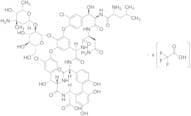
CAS:Controlled ProductFormula:C65H73Cl2N9O24(freeamine)Purity:>85%Color and Shape:NeatMolecular weight:1435.23Norvancomycin trifluoroacetate
CAS:Norvancomycin trifluoroacetate is an antibiotic compound, which is a glycopeptide derived from the bacterium Amycolatopsis orientalis. Its mode of action involves inhibiting bacterial cell wall synthesis. Specifically, Norvancomycin disrupts the cross-linking of peptidoglycan layers in the bacterial cell wall by binding to the D-alanyl-D-alanine terminus of cell wall precursors. This disruption weakens the bacterial cell wall, ultimately leading to cell lysis and death, thereby exerting a bactericidal effect.Formula:C65H73Cl2N9O24•(C2HF3O2)xPurity:Min. 95%Norvancomycin
CAS:Norvancomycin is an antimicrobial agent that is used as a treatment for infectious diseases. It prevents bacterial growth by binding to the D-alanyl-D-alanine moiety of the peptidoglycan cell wall, which inhibits cell wall synthesis. Norvancomycin has been shown to be effective against Gram-positive bacteria such as Staphylococcus aureus and Enterococcus faecalis and Gram-negative bacteria such as Escherichia coli and Pseudomonas aeruginosa. Norvancomycin also has the ability to inhibit transcriptional regulation, leading to decreased production of proteins essential for bacterial growth. Norvancomycin has been shown to have a long half-life in humans, making it useful for pharmacokinetic studies in human serum.
Formula:C65H73Cl2N9O24Purity:Min. 95%Molecular weight:1,435.23 g/molRef: 3D-FN164675
Discontinued product