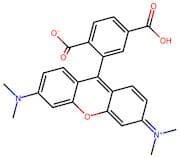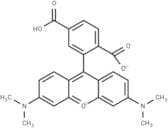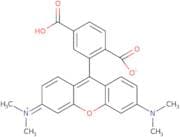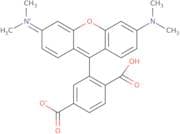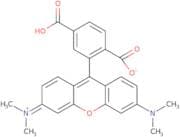
CAS 91809-67-5
:6-Carboxytetramethylrhodamine
- 4-carboxy-3-[6-(dimethylamino)-3-(dimethyliminio)-3H-xanthen-9-yl]benzoate
- 6-Carboxy-Tetramethylrhodamine, For Fluorescence
- 6-Tamra
- N,N,N′,N′-Tetramethyl-6-carboxyrhodamine
- Xanthylium, 9-(2,5-dicarboxyphenyl)-3,6-bis(dimethylamino)-, inner salt
- 6-Carboxytetramethylrhodamine
6-Carboxytetramethylrhodamine
CAS:Formula:C25H22N2O5Purity:95%Color and Shape:SolidMolecular weight:430.45266-Carboxytetramethylrhodamine
CAS:6-CarboxytetramethylrhodamineColor and Shape:PowderMolecular weight:430.45g/mol6-Carboxytetramethylrhodamine
CAS:Formula:C25H22N2O5Purity:≥ 90.0%Color and Shape:Black powderMolecular weight:430.456-TAMRA
CAS:6-TAMRA (6-Carboxytetramethylrhodamine) serves as a popular fluorophore for the creation of bioconjugates, particularly in the synthesis of fluorescentFormula:C25H22N2O5Purity:98.23%Color and Shape:SolidMolecular weight:430.456-Carboxytetramethylrhodamine
CAS:6-Carboxytetramethylrhodamine is a fine chemical that is used as a building block in the synthesis of other compounds. It has been used in research to study protein function and in the development of new drugs. 6-Carboxytetramethylrhodamine may be used as an intermediate or scaffold for complex molecules, and has been applied as a reagent in the study of DNA. Its versatility makes it a useful building block for many applications.Formula:C25H22N2O5Purity:Min. 80 Area-%Molecular weight:430.45 g/molRef: 3D-J-100076
1gTo inquire50mgTo inquire250mgTo inquire500mgTo inquire2500mgTo inquire-Unit-ggTo inquire6-Carboxytetramethyl rhodamine
CAS:6-Carboxytetramethyl rhodamine is a fluorescent dye that is used to measure the presence of cancer cells in urine samples. It binds to human protein and has been shown to be a useful probe for fluorescence measurements. 6-Carboxytetramethyl rhodamine has also been used as a fluorescence probe for the detection of proliferative diabetic retinopathy and michaelis–menten kinetics in cyclic peptides.
Formula:C25H22N2O5Purity:Min. 95%Color and Shape:PowderMolecular weight:430.45 g/mol6-Carboxy-tetramethylrhodamine
CAS:Formula:C25H22N2O5Purity:98%Color and Shape:SolidMolecular weight:430.466-Carboxytetramethyl rhodamine hydrochloride
CAS:6-Carboxytetramethyl rhodamine hydrochloride is a fluorescent probe that produces an intense red fluorescence when bound to nucleic acids and proteins. The fluorescence can be measured using a spectrofluorimeter, which is a device that measures the intensity of light emitted by cells in response to excitation by an ultraviolet or visible light source. 6-Carboxytetramethyl rhodamine hydrochloride has been used as a fluorescent probe for the detection of human protein in x-ray crystal structures. This probe has also been used to detect herpes simplex virus (HSV) and other DNA viruses. The basic properties of this compound are determined by its sequence and structure, which can be studied using molecular methods such as hybridization or proximal tubule analysis.
Formula:C25H22N2O5·HClPurity:Min. 95%Color and Shape:SolidMolecular weight:466.91 g/mol