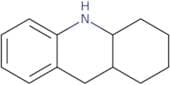
CAS 92039-20-8
:1,2,3,4,4a,9,9a,10-Octahydroacridine
Description:
1,2,3,4,4a,9,9a,10-Octahydroacridine, with the CAS number 92039-20-8, is a bicyclic organic compound characterized by its polycyclic structure, which includes a saturated acridine framework. This compound features multiple saturated carbon rings, contributing to its unique chemical properties. It is typically colorless to pale yellow and may exhibit a range of physical states depending on its purity and specific formulation. The presence of multiple carbon atoms in its structure suggests potential for various chemical reactivity, including hydrogen bonding and interactions with other organic molecules. Its applications may span across fields such as organic synthesis, pharmaceuticals, and materials science, where it could serve as a building block or intermediate in the synthesis of more complex compounds. Additionally, the compound's stability and solubility characteristics can vary based on the solvent used, making it important to consider these factors in practical applications. Overall, 1,2,3,4,4a,9,9a,10-Octahydroacridine represents a versatile compound with potential utility in various chemical contexts.
Formula:C13H17N
InChI:InChI=1S/C13H17N/c1-3-7-12-10(5-1)9-11-6-2-4-8-13(11)14-12/h1,3,5,7,11,13-14H,2,4,6,8-9H2
InChI key:InChIKey=LDGKFQONDQVMAF-UHFFFAOYSA-N
SMILES:C12C(NC=3C(C1)=CC=CC3)CCCC2
Synonyms:- Acridan, 1,2,3,4,4a,9a-hexahydro-
- 1,2,3,4,4a,9,9a,10-Octahydroacridine
- Acridine, 1,2,3,4,4a,9,9a,10-octahydro-
Sort by
Purity (%)
0
100
|
0
|
50
|
90
|
95
|
100
Found 1 products.
1,2,3,4,4a,9,9a,10-Octahydroacridine
CAS:1,2,3,4,4a,9,9a,10-Octahydroacridine (octahydroacridine) is an amine compound that has a high yield in the reaction scheme. The octahydroacridine molecule can be synthesized using a hydrogenation reaction with acid catalyst or by reacting a 3-substituted acrylonitrile with ammonia. The octahydroacridine molecule is a chiral compound and has two stereoisomers: 1R-octahydroacridine and 1S-octahydroacridine. These are differentiated by their ability to rotate plane polarized light in opposite directions.Formula:C13H17NPurity:Min. 95%Molecular weight:187.28 g/mol