CAS 92172-83-3
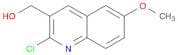
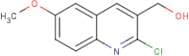
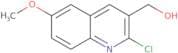
:(2-chloro-6-methoxyquinolin-3-yl)methanol
Description:
(2-Chloro-6-methoxyquinolin-3-yl)methanol is a chemical compound characterized by its quinoline structure, which features a chlorine atom and a methoxy group at specific positions on the ring. This compound typically exhibits properties associated with both aromatic and heterocyclic compounds, including stability and potential reactivity due to the presence of the hydroxymethyl group. The chlorine substituent can influence its reactivity and solubility, while the methoxy group may enhance its lipophilicity. The compound is likely to be a solid at room temperature and may have moderate solubility in organic solvents. Its structure suggests potential applications in medicinal chemistry, particularly in the development of pharmaceuticals, due to the biological activity often associated with quinoline derivatives. Additionally, the presence of functional groups such as the hydroxymethyl may allow for further chemical modifications, making it a versatile intermediate in organic synthesis. As with any chemical substance, safety data and handling precautions should be consulted before use.
Formula:C11H10ClNO2
InChI:InChI=1/C11H10ClNO2/c1-15-9-2-3-10-7(5-9)4-8(6-14)11(12)13-10/h2-5,14H,6H2,1H3
SMILES:COc1ccc2c(cc(CO)c(Cl)n2)c1
Synonyms:- (2-Chloro-6-methoxy-quinolin-3-yl)-methanol
- 3-Quinolinemethanol, 2-Chloro-6-Methoxy-
Sort by
Purity (%)
0
100
|
0
|
50
|
90
|
95
|
100
Found 4 products.
2-Chloro-6-methoxyquinoline-3-methanol
CAS:2-Chloro-6-methoxyquinoline-3-methanolPurity:95%Molecular weight:223.66g/mol2-Chloro-6-methoxyquinoline-3-methanol
CAS:2-Chloro-6-methoxyquinoline-3-methanol is a supramolecular compound that is made up of a quinoline derivative and an alcohol. It has two isomers, which can be distinguished by observing their reaction time. The synthesis of 2-chloro-6-methoxyquinoline-3-methanol begins with the reaction of synthons and zinc oxide nanoparticles. This reaction produces a helical structure, which is then heated to produce acrylonitrile. The final step in the synthesis of 2CQM is the dehydration of the acrylonitrile using hydrogen bond interactions and heat to give 2CQM. Crystal x-ray diffraction studies have shown that 2CQM has a conformational skeletal structure with a ZnO core surrounded by four chloride ions and six methoxy groups on each side.Formula:C11H10ClNO2Purity:Min. 95%Molecular weight:223.66 g/mol