CAS 92238-61-4
:2-Pyrimidinamine,4-cyclopropyl-6-methyl-
Description:
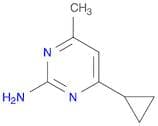
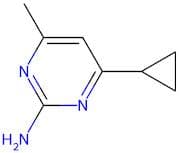
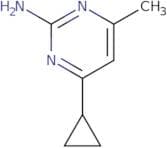
2-Pyrimidinamine, 4-cyclopropyl-6-methyl- is a chemical compound characterized by its pyrimidine ring structure, which is a six-membered aromatic ring containing two nitrogen atoms at positions 2 and 4. This compound features a cyclopropyl group and a methyl group attached to the pyrimidine ring, contributing to its unique properties. The presence of these substituents can influence the compound's reactivity, solubility, and biological activity. Typically, pyrimidine derivatives are of interest in medicinal chemistry due to their potential pharmacological applications, including antiviral and anticancer properties. The molecular structure of 2-Pyrimidinamine, 4-cyclopropyl-6-methyl- suggests it may interact with biological targets through hydrogen bonding and hydrophobic interactions. Additionally, its CAS number, 92238-61-4, allows for easy identification and retrieval of information regarding its synthesis, safety data, and potential applications in research and industry. Overall, this compound exemplifies the diverse chemistry of nitrogen-containing heterocycles.
Formula:C8H11N3
Synonyms:- 2-Pyrimidinamine, 4-cyclopropyl-6-methyl- (9CI)
Sort by
Purity (%)
0
100
|
0
|
50
|
90
|
95
|
100
Found 5 products.
4-Cyclopropyl-6-methylpyrimidin-2-amine
CAS:Formula:C8H11N3Purity:98%Color and Shape:SolidMolecular weight:149.19304-Cyclopropyl-6-methylpyrimidin-2-amine
CAS:4-Cyclopropyl-6-methylpyrimidin-2-amine is a nitrogenous compound that can be taken up by plants through their roots and transported to other parts of the plant. It is used as a fungicide and is labelled for use on anaerobic soils, which are not suitable for many agricultural purposes. The uptake of 4-cyclopropyl-6-methylpyrimidin-2-amine has been shown to be initially high in the presence of oxygen, but decreases with time. It is also radioactive, emitting γ rays at a rate of 0.0003% per hour. 4-Cyclopropyl-6-methylpyrimidin-2-amine reacts with cyprodinil to form a pyrimidine intermediate, which then reacts with oxygen to form a final product that can be detected by radioactivity. In addition, this molecule has been found to have antiinflammatory effects in mice.Formula:C8H11N3Purity:Min. 95%Molecular weight:149.19 g/mol