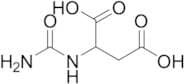
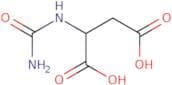
CAS 923-37-5
:Ureidosuccinic acid
Description:
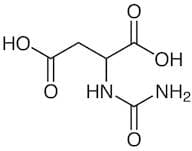
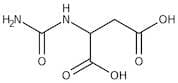
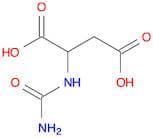
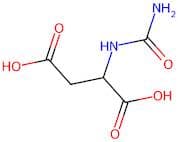
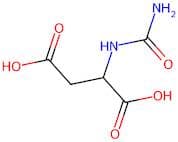
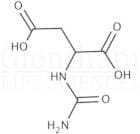
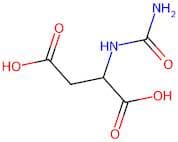
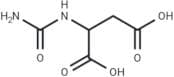
Ureidosuccinic acid, also known as 2-ureido-1,2,3-propanetricarboxylic acid, is an organic compound characterized by its unique structure that includes both ureido and carboxylic acid functional groups. It is a white crystalline solid that is soluble in water, reflecting its polar nature due to the presence of multiple carboxylic acid groups. This compound is often studied for its potential applications in biochemistry and pharmaceuticals, particularly in relation to its role as a metabolic intermediate. Ureidosuccinic acid can participate in various chemical reactions, including those involving amide formation and carboxylate interactions. Its molecular structure allows it to engage in hydrogen bonding, which contributes to its solubility and reactivity. Additionally, it may exhibit biological activity, making it of interest in research related to enzyme inhibition or as a building block in the synthesis of more complex molecules. Overall, ureidosuccinic acid is a versatile compound with significant implications in both chemical and biological contexts.
Formula:C5H8N2O5
InChI:InChI=1S/C5H8N2O5/c6-5(12)7-2(4(10)11)1-3(8)9/h2H,1H2,(H,8,9)(H,10,11)(H3,6,7,12)
InChI key:InChIKey=HLKXYZVTANABHZ-UHFFFAOYSA-N
SMILES:C(CC(O)=O)(NC(N)=O)C(O)=O
Synonyms:- (2R)-2-(carbamoylamino)butanedioate
- (2S)-2-(carbamoylamino)butanedioate
- 2-(Carbamoylamino)butanedioic acid
- 2-Ureidosuccinic acid
- <span class="text-smallcaps">DL</span>-2-Ureidobutanedioic acid
- <span class="text-smallcaps">DL</span>-Aspartic acid, N-(aminocarbonyl)-
- Aspartic acid, N-(aminocarbonyl)-
- Aspartic acid, N-carbamoyl-
- Aspartic acid, N-carbamoyl-, <span class="text-smallcaps">DL</span>-
- Carbamyl-<span class="text-smallcaps">DL</span>-aspartic acid
- N-(Aminocarbonyl)aspartic acid
- N-Carbamoyl-<span class="text-smallcaps">DL</span>-aspartic acid
- N-Carbamyl-DL-aspartic acid Ureidosuccinic acid
- NSC 120033
- Ureidosuccinic acid
- DL-Aspartic acid, N-(aminocarbonyl)-
- See more synonyms
Sort by
Purity (%)
0
100
|
0
|
50
|
90
|
95
|
100
Found 11 products.
N-Carbamoyl-DL-aspartic Acid
CAS:Formula:C5H8N2O5Purity:>98.0%(T)Color and Shape:White to Almost white powder to crystalMolecular weight:176.13N-Carbamoyl-DL-aspartic acid, 98%
CAS:N-Carbamoyl-DL-aspartic acid, is a useful biochemical for proteomics research. It is also used as a carbamate derivative which serves as an intermediate in pyrimidine biosynthesis. This Thermo Scientific Chemicals brand product was originally part of the Alfa Aesar product portfolio. Some documentaFormula:C5H8N2O5Purity:98%Color and Shape:White, PowderMolecular weight:176.13N-Carbamoyl-DL-aspartic acid
CAS:N-Carbamoyl-DL-aspartic acid
Purity:≥98%Molecular weight:176.13g/molN-Carbamoyl-DL-aspartic acid, 10mM (in DMSO)
CAS:N-Carbamoyl-DL-aspartic acid, 10mM (in DMSO)Purity:≥95%Molecular weight:176.13g/molN-Carbamoyl-DL-aspartic acid
CAS:N-Carbamoyl-DL-aspartic acid (Ureidosuccinic acid) is an intermediary product in pyrimidine biosynthesis.Formula:C5H8N2O5Purity:99.95%Color and Shape:SolidMolecular weight:176.13N-Carbamoyl-DL-aspartic Acid
CAS:Controlled ProductApplications N-Carbamoyl-DL-aspartic Acid (cas# 923-37-5) is a useful research chemical.
Formula:C5H8N2O5Color and Shape:NeatMolecular weight:176.13N-(Aminocarbonyl)aspartic acid
CAS:N-Aminocarbonyl-L-aspartic acid (NACD) is a molecule that is found in urine samples. It can be used as a biomarker to detect cancer, HIV infection, and many other diseases. The presence of NACD has been correlated with the development of acidosis, which is characterized by an increase in the pH of body fluids. The following are a few examples of how this product might be described on an eCommerce site: Rifapentine is an anti-tuberculosis drug that belongs to the class of rifamycins. It is the most active of the rifamycins for the treatment of tuberculosis. Rifapentine inhibits bacterial growth by binding to DNA-dependent RNA polymerase, thereby preventing transcription and replication. The high frequency of human activity has been shown using a patch-clamp technique on human erythrocytes. This active form is metabolized throughFormula:C5H8N2O5Purity:Min. 95%Color and Shape:PowderMolecular weight:176.13 g/mol