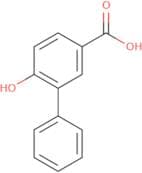
CAS 92379-11-8
:6-Hydroxy[1,1′-biphenyl]-3-carboxylic acid
Description:
6-Hydroxy[1,1′-biphenyl]-3-carboxylic acid, identified by its CAS number 92379-11-8, is an organic compound characterized by the presence of a biphenyl structure with hydroxyl and carboxylic acid functional groups. This compound typically exhibits properties associated with phenolic compounds, such as moderate solubility in polar solvents due to the hydroxyl group, while the carboxylic acid group can contribute to its acidity and potential for forming salts or esters. The biphenyl moiety provides a degree of hydrophobic character, influencing its interactions in biological and chemical systems. This compound may be of interest in various applications, including pharmaceuticals, agrochemicals, or as a building block in organic synthesis. Its structural features suggest potential for hydrogen bonding and participation in various chemical reactions, such as esterification or amidation. Additionally, the presence of multiple functional groups may allow for diverse reactivity, making it a versatile compound in synthetic organic chemistry.
Formula:C13H10O3
InChI:InChI=1S/C13H10O3/c14-12-7-6-10(13(15)16)8-11(12)9-4-2-1-3-5-9/h1-8,14H,(H,15,16)
InChI key:InChIKey=LPADJMFUBXMZNL-UHFFFAOYSA-N
SMILES:OC=1C(=CC(C(O)=O)=CC1)C2=CC=CC=C2
Synonyms:- 3-Biphenylcarboxylic acid, 6-hydroxy-
- 6-Hydroxy[1,1′-biphenyl]-3-carboxylic acid
- 6-Hydroxybiphenyl-3-carboxylic acid
- 4-Hydroxy-3-phenylbenzoic acid
- [1,1′-Biphenyl]-3-carboxylic acid, 6-hydroxy-
Sort by
Purity (%)
0
100
|
0
|
50
|
90
|
95
|
100
Found 1 products.
4-Hydroxy-3-phenylbenzoic acid
CAS:4-Hydroxy-3-phenylbenzoic acid is a liquid crystal that belongs to the class of homopolyesters. It is synthesized by reacting biphenyl with dimethylformamide and an alkali metal. The 4-hydroxy group in this compound reacts with the phenyl group to form a carbonate ester, which can be further reacted with a range of other organic compounds to produce polyesters. The optical properties of 4-hydroxyphenyl benzoic acid are determined by the degree of polymerisation and substitution on the aromatic ring, while it also forms a byproduct when used as a chemical intermediate. This compound can be studied using optical microscopy under various temperatures and pH levels.Formula:C13H10O3Purity:Min. 95%Molecular weight:214.22 g/mol