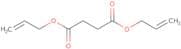
CAS 925-16-6
:1,4-Di-2-propen-1-yl butanedioate
Description:
1,4-Di-2-propen-1-yl butanedioate, also known as diallyl succinate, is an organic compound characterized by its structure, which features two allyl groups attached to a succinate backbone. This compound is typically a colorless to pale yellow liquid with a characteristic odor. It is soluble in organic solvents but has limited solubility in water. The presence of the allyl groups contributes to its reactivity, making it useful in various chemical reactions, including polymerization processes. Diallyl succinate can be utilized as a monomer in the production of polymers and resins, and it may also serve as a flavoring agent or in the synthesis of other chemical compounds. Its properties include a relatively low boiling point and a moderate density, which are typical for similar esters. Safety data indicates that it should be handled with care, as it may cause irritation upon contact with skin or eyes. Overall, 1,4-Di-2-propen-1-yl butanedioate is valued in both industrial and laboratory settings for its versatile chemical behavior.
Formula:C10H14O4
InChI:InChI=1S/C10H14O4/c1-3-7-13-9(11)5-6-10(12)14-8-4-2/h3-4H,1-2,5-8H2
InChI key:InChIKey=HABAXTXIECRCKH-UHFFFAOYSA-N
SMILES:C(CCC(OCC=C)=O)(OCC=C)=O
Synonyms:- Butanedioic acid, di-2-propenyl ester
- Succinic acid, diallyl ester
- Diallyl succinate
- Butanedioic acid, 1,4-di-2-propen-1-yl ester
- 1,4-Di-2-propen-1-yl butanedioate
Sort by
Purity (%)
0
100
|
0
|
50
|
90
|
95
|
100
Found 2 products.
Diallyl succinate
CAS:Diallyl succinate is an ester with the chemical formula CH3CH2OOC(CH2)5CH=CHCO2C(CH3)2. The compound has two ester linkages, one between the allyl carbonate and the succinic acid moiety and another between succinic acid and the methyl carbonate moiety. Diallyl succinate is a white crystalline solid that is soluble in ethanol, methanol, acetone, benzene and chloroform. It has an odor of garlic or onion. Diallyl succinate reacts with hydroxyl ions to form a polycarboxylic acid with two carboxyl groups. This molecule undergoes a series of reactions which result in its activation energy of 36 kJ/mol for intermolecular hydrogen bonding. Diallyl succinate can also react with fatty acids to produce monoesters containing one hydroxyl group. In diallyl succinate's NMRFormula:C10H14O4Purity:Min. 95%Color and Shape:Colourless Clear LiquidMolecular weight:198.22 g/mol