CAS 925-58-6
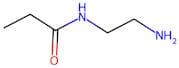
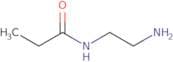
:N-(2-aminoethyl)propanamide
Description:
N-(2-aminoethyl)propanamide, also known as 3-(2-aminoethyl)propanamide, is an organic compound characterized by its amide functional group and an aminoethyl side chain. It features a propanamide backbone, which contributes to its polar nature, making it soluble in water and other polar solvents. The presence of both an amine and an amide group allows for potential hydrogen bonding, influencing its reactivity and interactions with other molecules. This compound is typically a colorless to light yellow liquid or solid, depending on its purity and temperature. It has applications in various fields, including pharmaceuticals and biochemistry, where it may serve as a building block for more complex molecules or as a reagent in synthetic pathways. Its molecular structure suggests it may exhibit biological activity, potentially interacting with biological systems due to the presence of the amino group. Safety data should be consulted for handling and storage, as with any chemical substance, to ensure proper precautions are taken.
Formula:C5H12N2O
InChI:InChI=1/C5H12N2O/c1-2-5(8)7-4-3-6/h2-4,6H2,1H3,(H,7,8)
SMILES:CCC(=NCCN)O
Synonyms:- propanamide, N-(2-aminoethyl)-
Sort by
Purity (%)
0
100
|
0
|
50
|
90
|
95
|
100
Found 3 products.
N-(2-Aminoethyl)propanamide
CAS:<p>N-(2-Aminoethyl)propanamide (NAPA) is a model compound for the investigation of the effect of laser ablation on the membrane properties and interactions with water. NAPA is a crosslinked, nanoparticle polymer with a large number of amide groups that are sensitive to laser irradiation. The 13C-NMR spectroscopy analysis showed that NAPA exhibits an osmotic response, which can be attributed to its high chloride content. Laser ablation has been shown to alter the environment within the cells and may affect their function by changing the permeability of membranes. The following are examples of product descriptions: 6-Fluoro-3-indoxyl-beta-D-galactopyranoside is an antituberculosis drug that belongs to the class of rifamycins. It is the most active of the rifamycins for the treatment of tuberculosis. Rifapentine inhibits</p>Formula:C5H12N2OPurity:Min. 95%Molecular weight:116.16 g/mol