CAS 926-79-4
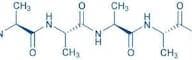
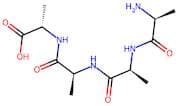
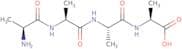
:N-L-alanyl-N-L-alanyl-N-L-alanyl-L-alanine
Description:
N-L-alanyl-N-L-alanyl-N-L-alanyl-L-alanine, also known as tri-alanylleucine, is a synthetic peptide composed of multiple alanine residues. This compound is characterized by its structure, which consists of three L-alanine amino acids linked together, typically through peptide bonds. The presence of multiple alanine units contributes to its hydrophobic nature, influencing its solubility and interaction with other molecules. Peptides like this one are often studied for their potential biological activities, including their role in protein synthesis and their effects on cellular processes. The compound may exhibit properties such as stability under physiological conditions and the ability to form secondary structures, which can be important for its function in biological systems. Additionally, its CAS number, 926-79-4, allows for easy identification in chemical databases. Overall, tri-alanylleucine serves as a model compound for understanding peptide behavior and interactions in various biochemical contexts.
Formula:C12H22N4O5
InChI:InChI=1/C12H22N4O5/c1-5(13)9(17)14-6(2)10(18)15-7(3)11(19)16-8(4)12(20)21/h5-8H,13H2,1-4H3,(H,14,17)(H,15,18)(H,16,19)(H,20,21)
SMILES:CC(C(=NC(C)C(=NC(C)C(=NC(C)C(=O)O)O)O)O)N
Synonyms:- H-Ala-Ala-Ala-Ala-OH
- Alanylalanylalanylalanine
Sort by
Purity (%)
0
100
|
0
|
50
|
90
|
95
|
100
Found 4 products.
H-Ala-Ala-Ala-Ala-OH
CAS:Tetraalanine is a substrate for carboxypeptidase P from pig kidneys.Formula:C12H22N4O5Color and Shape:White PowderMolecular weight:302.33L-Alanyl-L-alanyl-L-alanyl-L-alanine
CAS:L-Alanyl-L-alanyl-L-alanyl-L-alaninePurity:97%Molecular weight:302.33g/molL-Alanyl-L-Alanyl-L-Alanyl-L-Alanine
CAS:Controlled ProductApplications L-ALANYL-L-ALANYL-L-ALANYL-L-ALANINE (cas# 926-79-4) is a useful research chemical.
Formula:C12H22N4O5Color and Shape:NeatMolecular weight:302.33H-Ala-Ala-Ala-Ala-OH
CAS:H-Ala-Ala-Ala-Ala-OH is a peptide with a molecular weight of 268.3 g/mol and an amino acid sequence of H-Glu-Gly-Val-Asp-Phe. It has been shown to be a synthetic substrate for the enzyme dihydrofolate reductase, as well as being able to form stable complexes with copper ions. HFAHAH has been shown to have anti cancer properties in cell culture against Pseudomonas aeruginosa strains and has been found to inhibit the growth of human breast cancer cells by blocking protein synthesis. The conformational properties of this molecule are due to its amide group and the nitrogen atoms that are present on each side of the peptide backbone.
Formula:C12H22N4O5Purity:Min. 95%Molecular weight:302.33 g/mol