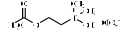
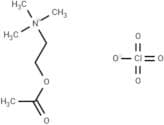
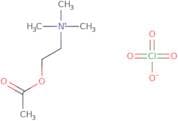
CAS 927-86-6
:Ethanaminium, 2-(acetyloxy)-N,N,N-trimethyl-, perchlorate (1:1)
Description:
Ethanaminium, 2-(acetyloxy)-N,N,N-trimethyl-, perchlorate (1:1), commonly known as trimethylacetylammonium perchlorate, is a quaternary ammonium compound characterized by its cationic structure, which includes a trimethylammonium group and an acetyl group. This compound is typically a white crystalline solid that is soluble in polar solvents such as water and alcohols, owing to its ionic nature. The presence of the perchlorate anion contributes to its stability and solubility. It is often used in various chemical applications, including as a reagent in organic synthesis and in studies involving ionic liquids. The compound exhibits properties typical of quaternary ammonium salts, such as surface activity and potential antimicrobial effects. However, due to the perchlorate ion, it may also pose environmental and health risks, necessitating careful handling and disposal. Overall, its unique structure and properties make it a subject of interest in both industrial and academic research contexts.
Formula:C7H16NO2·ClO4
InChI:InChI=1S/C7H16NO2.ClHO4/c1-7(9)10-6-5-8(2,3)4;2-1(3,4)5/h5-6H2,1-4H3;(H,2,3,4,5)/q+1;/p-1
InChI key:InChIKey=SHIQLFRCVFUYEK-UHFFFAOYSA-M
SMILES:Cl(=O)(=O)(=O)[O-].C(COC(C)=O)[N+](C)(C)C
Synonyms:- Choline acetate (ester), perchlorate
- Acetylcholine perchlorate
- Ethanaminium, 2-(acetyloxy)-N,N,N-trimethyl-, perchlorate (1:1)
- Choline, acetyl-, perchlorate
- Ethanaminium, 2-(acetyloxy)-N,N,N-trimethyl-, perchlorate
Sort by
Purity (%)
0
100
|
0
|
50
|
90
|
95
|
100
Found 4 products.
Acetylcholine perchlorate
CAS:Acetylcholine perchlorate, a neurotransmitter salt, enhances muscle contractions by amplifying sarcolemma action potentials.Formula:C7H16ClNO6Purity:98%Color and Shape:PowderMolecular weight:245.66Acetylcholine perchlorate
CAS:Acetylcholine perchlorate is a pharmacological agent that is used to induce acetylcholine release by the brain. It can be used to study cholinergic mechanisms in the brain and bowel disease. Acetylcholine perchlorate has been shown to have physiological effects, such as increasing heart rate and blood pressure, which may be due to its ability to activate nicotinic acetylcholine receptors. Acetylcholine perchlorate has also been shown to cause chemiluminescence reactions that are similar to those seen in biological studies of acetylcholine receptors.Formula:C7H16ClNO6Purity:Min. 95%Color and Shape:PowderMolecular weight:245.66 g/mol