CAS 92933-47-6
:5-Isopropyl-1H-pyrazole-3-carboxylic acid
Description:
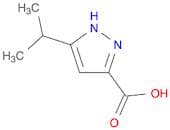
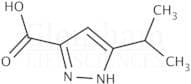
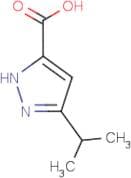
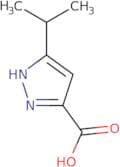
5-Isopropyl-1H-pyrazole-3-carboxylic acid is an organic compound characterized by its pyrazole ring structure, which is a five-membered ring containing two adjacent nitrogen atoms. This compound features an isopropyl group at the 5-position and a carboxylic acid functional group at the 3-position, contributing to its acidic properties. The presence of the isopropyl group enhances its hydrophobic characteristics, while the carboxylic acid group imparts polar characteristics, allowing for potential interactions with biological systems. This compound is often studied for its potential applications in pharmaceuticals and agrochemicals due to its ability to act as a building block in the synthesis of more complex molecules. Additionally, its unique structure may confer specific biological activities, making it of interest in medicinal chemistry. The compound is typically handled with standard safety precautions, as with many organic acids, and its stability and reactivity can be influenced by environmental conditions such as pH and temperature.
Formula:C7H10N2O2
InChI:InChI=1/C7H10N2O2/c1-4(2)5-3-6(7(10)11)9-8-5/h3-4H,1-2H3,(H,8,9)(H,10,11)
SMILES:CC(C)c1cc(C(=O)O)n[nH]1
Synonyms:- 1H-pyrazole-3-carboxylic acid, 5-(1-methylethyl)-
- 1H-Pyrazole-5-carboxylic acid, 3-(1-methylethyl)-
- 3-Isopropyl-1H-pyrazole-5-carboxylic acid
- 5-(propan-2-yl)-1H-pyrazole-3-carboxylic acid
- 5-Isopropyl-2H-pyrazole-3-carboxylic acid
Sort by
Purity (%)
0
100
|
0
|
50
|
90
|
95
|
100
Found 5 products.
5-isopropyl-1H-pyrazole-3-carboxylic acid
CAS:Formula:C7H10N2O2Purity:97%Color and Shape:SolidMolecular weight:154.16655-Isopropyl-2H-pyrazole-3-carboxylic acid
CAS:5-Isopropyl-2H-pyrazole-3-carboxylic acidPurity:99%Molecular weight:154.17g/mol5-Isopropyl-2 H -pyrazole-3-carboxylic acid
CAS:Formula:C7H10N2O2Purity:97%Color and Shape:White powderMolecular weight:154.1693-Isopropylpyrazole-5-carboxylic acid
CAS:3-Isopropylpyrazole-5-carboxylic acid is a luminescent compound that has been used as a ligand for europium. It has been shown to bind the metal and form a fluorescent complex. This compound is also able to act as an electron-accepting substrate for carboxylate.Formula:C7H10N2O2Purity:Min. 95%Molecular weight:154.17 g/mol