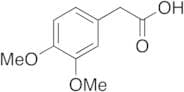
CAS 93-40-3
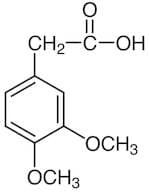
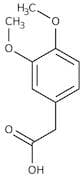
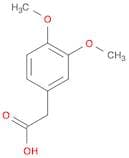
:(3,4-Dimethoxyphenyl)acetic acid
Description:
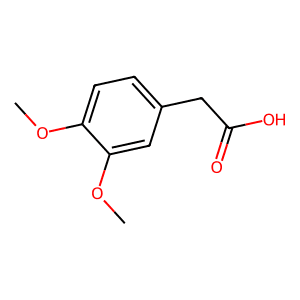
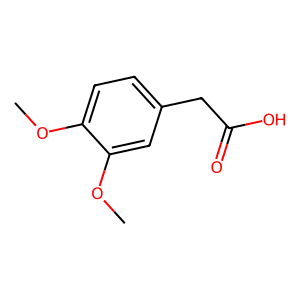
(3,4-Dimethoxyphenyl)acetic acid, with the CAS number 93-40-3, is an organic compound characterized by its aromatic structure and the presence of two methoxy groups (-OCH3) attached to a phenyl ring at the 3 and 4 positions. This compound features an acetic acid functional group (-COOH) that contributes to its acidic properties. It is typically a white to off-white solid at room temperature and is soluble in organic solvents such as ethanol and acetone, but less soluble in water due to its hydrophobic aromatic structure. The presence of the methoxy groups enhances its lipophilicity and can influence its biological activity. (3,4-Dimethoxyphenyl)acetic acid is of interest in various fields, including medicinal chemistry, where it may exhibit anti-inflammatory or analgesic properties. Its synthesis often involves the methylation of phenolic compounds followed by carboxylation. As with many organic acids, it should be handled with care, as it can be irritating to the skin and eyes.
Formula:C10H12O4
InChI:InChI=1S/C10H12O4/c1-13-8-4-3-7(6-10(11)12)5-9(8)14-2/h3-5H,6H2,1-2H3,(H,11,12)
InChI key:InChIKey=WUAXWQRULBZETB-UHFFFAOYSA-N
SMILES:O(C)C1=C(OC)C=C(CC(O)=O)C=C1
Synonyms:- (3,4-Dimethoxyphenyl)Acetate
- 2-(3,4-Dimethoxyphenyl)acetate
- 2-(3,4-Dimethoxyphenyl)acetic acid
- 3,4-Dimethoxybenzeneacetic acid
- 3,4-Dimethoxyphenylacetic acid
- 3,4-Dimethyloxy phenyl acetic acid
- Acetic acid, (3,4-dimethoxyphenyl)-
- Benzeneacetic acid, 3,4-dimethoxy-
- Dmpaa
- Homoveratric acid
- Homoveratricacid
- NSC 2753
- NSC 27897
- 3,4-Dimethoxyphenyl acetic acid
- See more synonyms
Sort by
Purity (%)
0
100
|
0
|
50
|
90
|
95
|
100
Found 10 products.
Homoveratric Acid
CAS:Formula:C10H12O4Purity:>98.0%(T)Color and Shape:White to Light yellow powder to crystalMolecular weight:196.203,4-Dimethoxyphenylacetic acid, 98%
CAS:It reacts with formaldehyde in the presence of acid to give an isochromanone. This Thermo Scientific Chemicals brand product was originally part of the Alfa Aesar product portfolio. Some documentation and label information may refer to the legacy brand. The original Alfa Aesar product / item code oFormula:C10H12O4Purity:98%Color and Shape:Powder, Pale creamMolecular weight:196.20(3,4-Dimethoxyphenyl) Acetic Acid
CAS:Formula:C10H12O4Purity:97%Color and Shape:SolidMolecular weight:196.19993,4-Dimethoxyphenylacetic acid
CAS:3,4-Dimethoxyphenylacetic acid (Homoveratrumic acid) is the papaverine intermediate, used to synthesis cardiovascular drugs.Formula:C10H12O4Purity:99.63%Color and Shape:SolidMolecular weight:196.23,4-Dimethoxyphenylacetic acid
CAS:3,4-Dimethoxyphenylacetic acidPurity:≥98%Molecular weight:196.2g/mol3,4-Dimethoxyphenylacetic acid (Homoveratric acid)
CAS:Formula:C10H12O4Purity:≥ 98.0%Color and Shape:White to beige powderMolecular weight:196.203,4-Dimethoxyphenylacetic acid
CAS:3,4-Dimethoxyphenylacetic acidFormula:C10H12O4Purity:98%Color and Shape: white solidMolecular weight:196.20g/mol(3,4-Dimethoxy-phenyl)-acetic acid
CAS:Formula:C10H12O4Purity:97%Color and Shape:Solid, Crystalline PowderMolecular weight:196.2023,4-Dimethoxyphenylacetic acid
CAS:3,4-Dimethoxyphenylacetic acid is an aromatic acid that has antimicrobial properties. It is used as a food additive for the preservation of meat and poultry. The 3,4-dimethoxyphenyl group in this molecule is an intramolecular hydrogen acceptor. This property allows it to undergo transfer reactions with other molecules, such as protocatechuic acid and lignin. 3,4-Dimethoxyphenylacetic acid also inhibits cellular physiology and can be used in the treatment of bacteria in biological systems. The hydroxyl group can form an acidic compound by reacting with a proton donor, such as water or trifluoroacetic acid (TFA). This reaction may be catalyzed by the enzyme cytochrome P450 reductase.Formula:C10H12O4Purity:Min. 95%Color and Shape:White PowderMolecular weight:196.2 g/mol(3,4-Dimethoxyphenyl)acetic Acid(Homoveratric Acid)
CAS:Controlled ProductApplications Homoveratric Acid is a dopamine metabolite that inhibits brain mitochondrial respiration via monoamine oxidase/H2O2-dependent or non-dependent pathway.
References Gluck, M.R. et al.: J. Neurochem., 91, 788 (2004); Morikawa, N. et al.: J. Neurochem., 66, 1174 (1996); Goodwin, B.L. et al.: Xenobiotica, 24, 129 (1994);Formula:C10H12O4Color and Shape:NeatMolecular weight:196.2