CAS 93-47-0
:verazide
Description:
Verazide, with the CAS number 93-47-0, is a chemical compound that belongs to the class of azole derivatives. It is primarily recognized for its application in the field of pharmaceuticals, particularly as an antihypertensive agent. The compound exhibits a unique molecular structure that contributes to its biological activity, including the ability to modulate vascular tone and influence blood pressure regulation. Verazide is typically characterized by its solubility in organic solvents and limited solubility in water, which can affect its bioavailability and pharmacokinetics. Additionally, it may possess specific functional groups that enhance its interaction with biological targets. Safety and handling precautions are essential when working with this compound, as it may have associated health risks. Overall, verazide's properties make it a subject of interest in medicinal chemistry and pharmacology, warranting further research into its mechanisms of action and potential therapeutic applications.
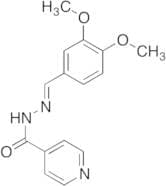
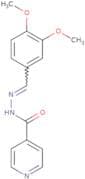
Formula:C15H15N3O3
InChI:InChI=1/C15H15N3O3/c1-20-13-4-3-11(9-14(13)21-2)10-17-18-15(19)12-5-7-16-8-6-12/h3-10H,1-2H3,(H,18,19)
SMILES:COc1ccc(cc1OC)C=NNC(=O)c1ccncc1
Synonyms:- Verazide [INN:BAN]
- 1-Isonicotinoyl-2-veratrylidenehydrazine
- 1-Isonicotinoyl-2-verotrylidenhydrazin
- N'-Veratryliden-isonicotinohydrazid
- Nsc 180261
- Nicotazide
- Unii-Xo8D6I4I5L
- Verazidum
- N'-(3,4-dimethoxybenzylidene)pyridine-4-carbohydrazide
- Verazide
Sort by
Purity (%)
0
100
|
0
|
50
|
90
|
95
|
100
Found 2 products.
Verazide
CAS:Controlled ProductApplications Verazide is derived from Isoniazid (I821450), which is an antibiotic for treatment of Mycobacterium tuberculosis, inhibits mycolic acid biosynthesis. Metabolized by hepatic N-acetyltransferase (NAT) and cytochrome P450 2E1 (CYP2E1) to form hepatotoxins. Selectively induces expression of CYP2E1. Reversibly inhibits CYP2C19 and CYP3A4 activities, and mechanistically inactivates CYP1A2, CYP2A6, CYP2C19 and CYP3A4 at clinically relevant concentrations. Antibacterial (tuberculostatic).
References Brewer, G.A., et al.: Anal. Profiles Drug Subs., 6, 183 (1977), Weber, W.W., et al.: Clin. Pharmacokinet., 4, 401 (1979)Formula:C15H15N3O3Color and Shape:NeatMolecular weight:285.298Verazide
CAS:Verazide is an oxide that acts as an enzyme inhibitor. It is a white, crystalline solid with a molecular weight of 199.22 g/mol and an empirical formula of C6H14O4N2O3. The hydroxyl group on the molecule forms hydrogen bonding interactions with amino acid residues in the active site of enzymes, inhibiting their function. Verazide inhibits bacterial growth by binding to the ribosomal RNA at the 50S subunit, preventing protein synthesis and thus cell division. It also has antiviral properties and can be used to treat hepatitis B and C as well as cardiovascular diseases such as cirrhosis or renovascular disease. Verazide is not active against viruses that replicate through DNA intermediates, such as herpesviruses or adenoviruses.Formula:C15H15N3O3Purity:Min. 95%Molecular weight:285.3 g/mol