

![N-[[1,2-Dihydro-4-hydroxy-2-oxo-1-(phenylmethyl)-3-quinolinyl]carbonyl]glycine](/_next/image/?url=https%3A%2Fstatic.cymitquimica.com%2Fcas-image%2Fthumb-webp%2F344945-n-12-dihydro-4-hydroxy-2-oxo-1-phenylmethyl-3-quinolinyl-carbonyl-glycine.webp&w=3840&q=75)
CAS 931398-72-0
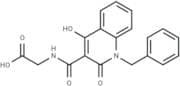
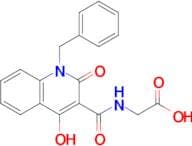
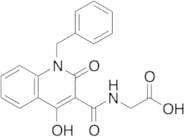
:N-[[1,2-Dihydro-4-hydroxy-2-oxo-1-(phenylmethyl)-3-quinolinyl]carbonyl]glycine
Description:
N-[[1,2-Dihydro-4-hydroxy-2-oxo-1-(phenylmethyl)-3-quinolinyl]carbonyl]glycine, with the CAS number 931398-72-0, is a synthetic compound that belongs to the class of quinoline derivatives. This substance features a quinoline core, which is characterized by a bicyclic structure containing a nitrogen atom in the aromatic ring. The presence of a carbonyl group linked to glycine suggests that it may exhibit properties related to amino acids, potentially influencing its biological activity. The hydroxyl and carbonyl functional groups contribute to its reactivity and solubility in various solvents. This compound may be of interest in medicinal chemistry due to its potential pharmacological properties, including anti-inflammatory or antimicrobial activities, although specific biological data would be necessary to confirm such effects. Its structural complexity and functional groups indicate that it could participate in various chemical reactions, making it a candidate for further research in drug development or biochemical applications.
Formula:C19H16N2O5
InChI:InChI=1S/C19H16N2O5/c22-15(23)10-20-18(25)16-17(24)13-8-4-5-9-14(13)21(19(16)26)11-12-6-2-1-3-7-12/h1-9,24H,10-11H2,(H,20,25)(H,22,23)
SMILES:c1ccc(cc1)Cn1c2ccccc2c(c(C(=NCC(=O)O)O)c1=O)O
Synonyms:- N-[(1-Benzyl-4-hydroxy-2-oxo-1,2-dihydro-3-quinolinyl)carbonyl]glycine
- Iox2
Sort by
Purity (%)
0
100
|
0
|
50
|
90
|
95
|
100
Found 5 products.
IOX2
CAS:IOX2 is a selective HIF PHD inhibitor, active in cells with 21 nM IC50 for PHD2/ELGN-1, not inhibiting FIH at 20uM.Formula:C19H16N2O5Purity:98% - 99.59%Color and Shape:SolidMolecular weight:352.34N-[(1-Benzyl-4-hydroxy-2-oxo-1,2-dihydro-3-Quinolinyl)carbonyl]glycin
CAS:Controlled ProductN-[(1-Benzyl-4-hydroxy-2-oxo-1,2-dihydro-3-Quinolinyl)carbonyl]glycin is a magnetic nanoparticle that can be used for cancer therapy. It has been shown to produce heat in the body and to target tumours. N-[(1-Benzyl-4-hydroxy-2-oxo-1,2-dihydro-3-Quinolinyl)carbonyl]glycin has also been used to monitor temperature changes in the body. The sensor is made of ferrite and biodegradable polymers and can be applied as a coating on devices that are used for cancer detection. This material is responsive to light emission, which provides an additional data point for monitoring the progression of cancer. Magnetic particles have also been used in conjunction with this sensor to target tumours by increasing permeability at the site of application.Purity:Min. 95%Ref: 3D-FB40518
Discontinued product




![N-[(1-Benzyl-4-hydroxy-2-oxo-1,2-dihydro-3-Quinolinyl)carbonyl]glycin](/_next/image/?url=https%3A%2Fstatic.cymitquimica.com%2Fproducts%2F3D%2Fthumb%2FFB40518.jpg&w=3840&q=75)
