CAS 932-51-4
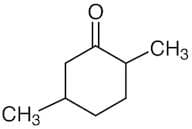
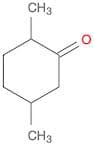
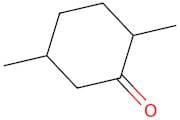
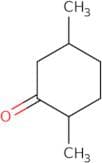
:Dimethylcyclohexanone, 95%
Description:
Dimethylcyclohexanone, with the CAS number 932-51-4, is an organic compound characterized by its cyclic structure and ketone functional group. It is a colorless to pale yellow liquid with a distinctive odor, commonly used as a solvent and in the synthesis of various chemical compounds. The presence of two methyl groups on the cyclohexanone ring contributes to its chemical properties, including moderate polarity and solubility in organic solvents. This compound typically exhibits a boiling point that is higher than that of simple ketones due to the steric hindrance introduced by the methyl groups. Dimethylcyclohexanone is stable under normal conditions but should be handled with care, as it can be irritating to the skin and eyes. It is important to store it in a cool, well-ventilated area away from sources of ignition. In industrial applications, it serves as an intermediate in the production of fragrances, pharmaceuticals, and other specialty chemicals.
Formula:C8H14O
InChI:InChI=1S/C8H14O/c1-6-3-4-7(2)8(9)5-6/h6-7H,3-5H2,1-2H3
SMILES:CC1CCC(C)C(=O)C1
Synonyms:- 2,5-Dimethylcyclohexanone (mixture of isomers)
Sort by
Purity (%)
0
100
|
0
|
50
|
90
|
95
|
100
Found 5 products.
2,5-Dimethylcyclohexanone (mixture of isomers)
CAS:Formula:C8H14OPurity:>95.0%(GC)Color and Shape:Colorless to Light orange to Yellow clear liquidMolecular weight:126.202,5-dimethylcyclohexan-1-one
CAS:Formula:C8H14OPurity:95%Color and Shape:LiquidMolecular weight:126.19622,5-Dimethylcyclohexanone
CAS:2,5-DimethylcyclohexanonePurity:99%,mixture of isomersMolecular weight:126.2g/mol2,5-Dimethylcyclohexanone
CAS:2,5-Dimethylcyclohexanone is a reactive methyl ketone that can be used to synthesize organic molecules. It has been shown to react with alkyl lithium reagents such as organolithium and allyllithium. This reaction can be used to generate alcohols, amines, and other compounds. The product of the reaction depends on the type of R group on the 2,5-dimethylcyclohexanone molecule. For example, when R is an electron-withdrawing group such as a phenyl group or trans-stilbene, the product is an α-alkylated β-unsaturated ketone. When R is a hydrogen atom or methyl group, the product is an alkanol or amine respectively. 2,5-Dimethylcyclohexanone can also be used as an acceptor in conformational equilibration reactions because it has two methyl groups that are orthogonal to each otherFormula:C8H14OPurity:Min. 95%Molecular weight:126.2 g/mol