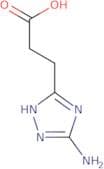
CAS 933753-12-9
:3-(5-amino-1H-1,2,4-triazol-3-yl)propanoic acid
Description:
3-(5-amino-1H-1,2,4-triazol-3-yl)propanoic acid is an organic compound characterized by its triazole ring and a propanoic acid functional group. The presence of the amino group on the triazole ring contributes to its potential as a bioactive molecule, possibly influencing its solubility and reactivity. This compound typically exhibits properties such as being a white to off-white solid, with moderate solubility in polar solvents due to the presence of both the amino and carboxylic acid functional groups. Its molecular structure suggests potential applications in pharmaceuticals, particularly in the development of antimicrobial or antifungal agents, owing to the triazole moiety's known biological activity. Additionally, the compound may participate in various chemical reactions, including coupling reactions and modifications, making it a versatile intermediate in organic synthesis. Safety data should be consulted for handling and storage, as with any chemical substance, to ensure proper laboratory practices are followed.
Formula:C5H8N4O2
InChI:InChI=1/C5H8N4O2/c6-5-7-3(8-9-5)1-2-4(10)11/h1-2H2,(H,10,11)(H3,6,7,8,9)
SMILES:C(CC(=O)O)c1nc(=N)[nH][nH]1
Sort by
Purity (%)
0
100
|
0
|
50
|
90
|
95
|
100
Found 1 products.
3-(3-Amino-1H-1,2,4-triazol-5-yl)propanoic acid
CAS:Aminoguanidine is a selective inhibitor of the enzyme succinic dehydrogenase, which catalyzes the conversion of succinic acid to fumarate. Aminoguanidine is used in the treatment of diabetic complications and other conditions that result from high levels of blood glucose in order to lower the levels of blood sugar. The drug is administered orally or intravenously as aminoguanidine hydrochloride, which is converted to aminoguanidine in the body. Aminoguanidine can also be synthesized by reacting succinic anhydride with guanidine hydrochloride in a regioselective reaction. This synthesis yields quantitatively aminoguanidine, with little or no formation of guanidine. The product can be purified by washing with alkali and recrystallizing it from water. X-ray diffraction studies have shown that aminoguanidine hydrochloride exists as zwitterions in solution at physiological pH values.Formula:C5H8N4O2Purity:Min. 95%Molecular weight:156.14 g/mol