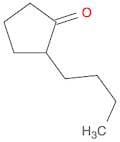
CAS 934-42-9
:2-Butylcyclopentanone
Description:
2-Butylcyclopentanone is a cyclic ketone characterized by a cyclopentane ring with a butyl group attached to one of the carbon atoms. Its molecular formula is C10H18O, indicating the presence of ten carbon atoms, eighteen hydrogen atoms, and one oxygen atom. This compound typically appears as a colorless to pale yellow liquid with a distinctive odor. It has a moderate boiling point and is soluble in organic solvents, but its solubility in water is limited due to its hydrophobic nature. 2-Butylcyclopentanone is used in various applications, including as an intermediate in organic synthesis and in the production of fragrances and flavoring agents. Its reactivity is influenced by the ketone functional group, which can participate in nucleophilic addition reactions. Safety data indicates that, like many organic solvents, it should be handled with care, as it may cause irritation upon contact with skin or eyes and should be used in well-ventilated areas to avoid inhalation of vapors.
Formula:C9H16O
InChI:InChI=1S/C9H16O/c1-2-3-5-8-6-4-7-9(8)10/h8H,2-7H2,1H3
InChI key:InChIKey=ZAQYRXDJFINJJE-UHFFFAOYSA-N
SMILES:C(CCC)C1C(=O)CCC1
Synonyms:- 2-Butyl-1-cyclopentanone
- 2-n-Butylcyclopentanone
- Ai3-36552
- Cyclopentanone, 2-butyl-
- 2-Butylcyclopentanone
- 2-Butylcyclopentanone
Sort by
Purity (%)
0
100
|
0
|
50
|
90
|
95
|
100
Found 2 products.
2-Butylcyclopentanone
CAS:2-Butylcyclopentanone is a protonated molecule that can be used in the kinetic protonation of alkyl halides. It has been shown to catalyze the formation of chiral carbanions from enolates and to form stereoisomers by kinetic asymmetric addition. The homologous series of 2-butylcyclopentanones has been studied extensively, as these molecules have been shown to have a wide range of uses, including as catalysts and reagents in organic synthesis. The mechanistic studies on this molecule have revealed that it is an electrophilic alkylation agent that reacts with nucleophiles at the protonated carbon atom. The selectivity of this reaction depends on the reactivity of the nucleophile, with more reactive nucleophiles leading to higher levels of selectivity. Protonation and alkylation are reversible processes and equilibrium constants for these reactions can be determined experimentally by measuring rates for both forward andFormula:C9H16OPurity:Min. 95%Molecular weight:140.22 g/mol