CAS 934743-11-0
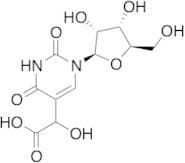
:1,2,3,4-Tetrahydro-α-hydroxy-2,4-dioxo-1-β-D-ribofuranosyl-5-pyrimidineacetic acid
Description:
1,2,3,4-Tetrahydro-α-hydroxy-2,4-dioxo-1-β-D-ribofuranosyl-5-pyrimidineacetic acid, with the CAS number 934743-11-0, is a chemical compound that features a complex structure incorporating both a ribofuranosyl moiety and a pyrimidineacetic acid component. This compound is characterized by its tetrahydro structure, which indicates the presence of a saturated cyclic system, and the presence of hydroxyl and dicarbonyl functional groups, contributing to its reactivity and potential biological activity. The ribofuranosyl part suggests that it may have nucleoside-like properties, which could be relevant in biochemical contexts, particularly in relation to nucleic acid metabolism or as a potential therapeutic agent. The compound's specific stereochemistry and functional groups may influence its solubility, stability, and interactions with biological targets. Overall, this compound represents a unique blend of features that could be of interest in medicinal chemistry and biochemistry research.
Formula:C11H14N2O9
InChI:InChI=1S/C11H14N2O9/c14-2-4-6(16)7(17)9(22-4)13-1-3(5(15)10(19)20)8(18)12-11(13)21/h1,4-7,9,14-17H,2H2,(H,19,20)(H,12,18,21)/t4-,5?,6-,7-,9-/m1/s1
InChI key:InChIKey=UVGCZRPOXXYZKH-QADQDURISA-N
SMILES:O=C1N(C=C(C(C(O)=O)O)C(=O)N1)[C@@H]2O[C@H](CO)[C@@H](O)[C@H]2O
Synonyms:- 5-Carboxyhydroxymethyl-uridine
- 1,2,3,4-Tetrahydro-α-hydroxy-2,4-dioxo-1-β-D-ribofuranosyl-5-pyrimidineacetic acid
- 5-Pyrimidineacetic acid, 1,2,3,4-tetrahydro-α-hydroxy-2,4-dioxo-1-β-D-ribofuranosyl-
- 5-(2-HO-carboxymethyl) uridine
Sort by
Purity (%)
0
100
|
0
|
50
|
90
|
95
|
100
Found 2 products.
5-Carboxyhydroxymethyluridine
CAS:5-Carboxyhydroxymethyluridine is a hydroxylated nucleoside that is used to study DNA repair. It is a nucleotide analogue that has been modified at the hydroxyl group by methylation. 5-Carboxyhydroxymethyluridine can be converted back to uridine by escherichia coli hydroxylases, but this conversion does not occur in vivo. 5-Carboxyhydroxymethyluridine can be used as a substrate for methyltransferase enzymes, which are involved in DNA repair. The enzyme 5'-methylthioadenosine phosphorylase converts 5-carboxyhydroxymethyluridine into S-adenosylhomocysteine and adenine. This conversion can be reversed by the enzyme methionine synthase. Some homologues of 5-carboxyhydroxymethyluridine have been found in nature and other modifications have been made on theFormula:C11H14N2O9Purity:Min. 95%Color and Shape:PowderMolecular weight:318.24 g/mol5-Carboxyhydroxymethyluridine
CAS:Controlled ProductApplications 5-Carboxyhydroxymethyluridine is a naturally occuring modified nucleoside in RNA that assists in RNA stability, folding and other functions.
References Aduri, R., et al.: J. Chem. Theory Comput., 3, 1464 (2007); Xu, Y., et al.: J. Comput. Chem., 37, 896 (2016)Formula:C11H14N2O9Color and Shape:NeatMolecular weight:318.237