CAS 93487-20-8
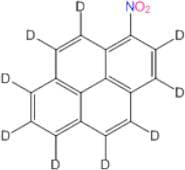
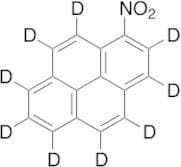
:Pyrene-1,2,3,4,5,6,7,9,10-d9,8-nitro-
Description:
Pyrene-1,2,3,4,5,6,7,9,10-d9,8-nitro- is a deuterated derivative of pyrene, a polycyclic aromatic hydrocarbon (PAH) known for its fluorescent properties. The presence of deuterium atoms (d9) indicates that hydrogen atoms in the pyrene structure have been replaced with deuterium, which is a stable isotope of hydrogen. This modification can enhance the compound's stability and alter its spectroscopic properties, making it useful in various analytical applications, including nuclear magnetic resonance (NMR) spectroscopy. The nitro group (-NO2) attached to the pyrene structure introduces additional reactivity and can influence the compound's electronic properties, potentially enhancing its utility in organic synthesis and materials science. Pyrene derivatives are often studied for their applications in organic electronics, photonics, and as probes in biological systems due to their unique optical characteristics. As with many nitro-substituted compounds, care should be taken regarding their handling and potential toxicity.
Formula:C16D9NO2
Synonyms:- 1-Nitropyrene-d9
Sort by
Purity (%)
0
100
|
0
|
50
|
90
|
95
|
100
Found 3 products.
1-Nitropyrene-d9
CAS:Controlled ProductApplications 1-Nitropyrene-d9 is a labelled isotope of 1-Nitropyrene (N519950), which is the most abundant nitropolycylcic aromatic hydrocarbon found in exhaust from diesel engines with potent carcinogenic and mutagenic properties. It is also an intermediate in synthesizing 1-Aminopyrene-d9 (A629287), which is derived from Pyrene-d10 (P849002), which is labelled Pyrene. Occurs in coal tar. Also obtained by the destructive hydrogenation of hard coal.
References Arce, R., et al.: J. Phys. Chem. A., 112, 10294 (2008); Winterstein, et al.: Z. Physiol. Chem., 230, 162 (1934);Formula:C162H9NO2Color and Shape:NeatMolecular weight:256.3