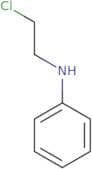
CAS 935-06-8
:N-(2-Chloroethyl)benzenamine
Description:
N-(2-Chloroethyl)benzenamine, with the CAS number 935-06-8, is an organic compound characterized by the presence of both an amine and a chloroalkyl group. It features a benzene ring substituted with an amino group (–NH2) and a 2-chloroethyl group (–CH2CH2Cl), which contributes to its reactivity and potential applications in organic synthesis. This compound is typically a colorless to pale yellow liquid or solid, depending on its purity and specific conditions. It is known for its ability to participate in nucleophilic substitution reactions due to the presence of the chlorine atom, making it useful in the synthesis of various pharmaceuticals and agrochemicals. Additionally, N-(2-Chloroethyl)benzenamine may exhibit moderate toxicity and should be handled with care, following appropriate safety protocols. Its physical properties, such as boiling point and solubility, can vary based on environmental conditions and the presence of other substances. Overall, this compound serves as an important intermediate in chemical synthesis and research.
Formula:C8H10ClN
InChI:InChI=1/C8H10ClN/c9-6-7-10-8-4-2-1-3-5-8/h1-5,10H,6-7H2
InChI key:InChIKey=KTDILAZSFSAPMD-UHFFFAOYSA-N
SMILES:N(CCCl)C1=CC=CC=C1
Synonyms:- N-(2-Chloroethyl)aniline
- N-(2-Chloroethyl)benzenamine
- N-(Chloroethyl)aniline
- Aniline, N-(2-chloroethyl)-
- Benzenamine, N-(2-chloroethyl)-
Sort by
Purity (%)
0
100
|
0
|
50
|
90
|
95
|
100
Found 1 products.
N-(2-Chloroethyl)aniline
CAS:N-(2-Chloroethyl)aniline is a chemical compound that contains the functional groups of aniline and chloroethane. The reaction rate of N-(2-chloroethyl)aniline with DNA is damaging, which may lead to covalent adducts. This chemical can also form bifunctional molecules with DNA, which can be toxic to cells. Furthermore, this molecule has shown antitumour activity and has been used in chemotherapy for patients with cancer. It has also been shown to activate receptor α and induce cell apoptosis. N-(2-Chloroethyl)aniline can be conjugated with fk506 or other drugs to produce reactive derivatives that have a more selective action on tumour cells than on normal cells.Formula:C8H10ClNPurity:Min. 95%Molecular weight:155.62 g/mol