CAS 936643-80-0
:2-(Chloromethyl)pyrimidine hydrochloride
Description:
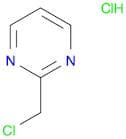
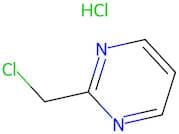
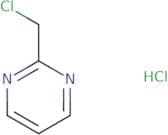
2-(Chloromethyl)pyrimidine hydrochloride is a chemical compound characterized by its pyrimidine ring structure, which is a six-membered aromatic heterocycle containing two nitrogen atoms at positions 1 and 3. This compound features a chloromethyl group (-CH2Cl) attached to the pyrimidine ring, enhancing its reactivity and making it useful in various synthetic applications. As a hydrochloride salt, it is typically encountered in a crystalline form, which is soluble in polar solvents such as water and alcohols. The presence of the chloromethyl group allows for nucleophilic substitution reactions, making it valuable in medicinal chemistry and the synthesis of pharmaceuticals. Additionally, the compound may exhibit biological activity, although specific pharmacological properties would depend on its derivatives and the context of use. Safety data should be consulted, as it may pose hazards typical of chlorinated compounds, including potential toxicity and environmental concerns. Proper handling and storage conditions are essential to ensure safety during its use in laboratory or industrial settings.
Formula:C5H5ClN2ClH
InChI:InChI:1S/C5H5ClN2.ClH/c6-4-5-7-2-1-3-8-5;/h1-3H,4H2;1H
InChI key:InChIKey=XLGVMJXAZRCTRU-UHFFFAOYSA-N
SMILES:C(Cl)C=1N=CC=CN1.Cl
Sort by
Purity (%)
0
100
|
0
|
50
|
90
|
95
|
100
Found 4 products.
2-(Chloromethyl)pyrimidine hydrochloride
CAS:Formula:C5H6Cl2N2Purity:95%Color and Shape:SolidMolecular weight:165.02052-(Chloromethyl)pyrimidine hydrochloride
CAS:2-(Chloromethyl)pyrimidine hydrochloride
Purity:97%Molecular weight:165.02g/mol2-(Chloromethyl)pyrimidine HCl
CAS:2-(Chloromethyl)pyrimidine HCl is a chlorinated aromatic compound that is used in the manufacturing of nylon and other synthetic fibers. It is an intermediate for the production of polychloroparaffins, which are used as solvents and raw materials in the chemical industry. 2-(Chloromethyl)pyrimidine HCl has been shown to undergo a chlorination reaction with alcohols to produce 4-chloro-2-methyl-1,3-dioxolane. This reaction can be catalyzed by calcium hydroxide or magnesium chloride, which are both common chemicals found in household cleaners.Formula:C5H5ClN2·HClPurity:Min. 95%Color and Shape:Yellow PowderMolecular weight:165.02 g/mol2-(Chloromethyl)pyrimidine hydrochloride
CAS:Formula:C5H6Cl2N2Purity:95%Color and Shape:SolidMolecular weight:165.02